E-commerce
How Much Should You Spend on Ads? Work It Backward From Your Economics
Not a benchmark article. A worksheet: derive your ad budget from margin, close rate, and capacity — then let performance, not a percentage rule, decide when to raise it.

PPC & Creative Strategist
"How much should I spend on ads?" is usually answered with folklore: spend 10% of revenue, start with $20 a day, match your competitors.
All of it dodges the real question. Your ad budget isn't a percentage of anything — it's a function of three numbers you already have: what a customer is worth, what a conversion can afford to cost, and how many conversions you can actually handle. This article walks through the arithmetic I do with every client before a single campaign launches.
TL;DR
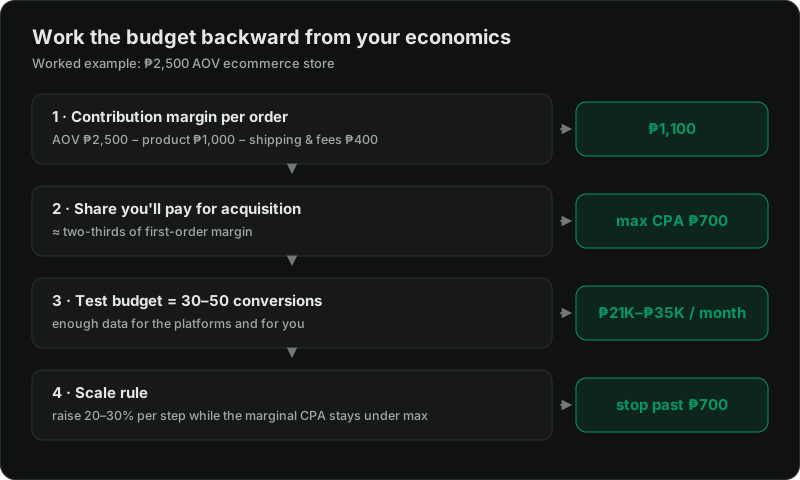
Step 1: What can a conversion afford to cost?
Ecommerce. Take one typical order:
$32 is the most you can pay for a first purchase and break even before overhead. If roughly 30% of customers buy again, observed lifetime contribution may be higher — say $44–$54 in this example — and you can decide how much of that future value you are willing to spend today. A business that only counts first-order margin can under-bid; one that spends full projected LTV on day one can run out of cash waiting for reorders. Work through your real numbers with the customer LTV guide.
Services and lead gen. Chain the funnel:
Every number in that chain matters. If close rate is actually 8% and not 20%, your affordable CPL drops from $200 to $80 — which is why lead quality tracking is not optional. More on that in getting leads but no clients.
If you can't fill in these numbers, that's the real finding: you're not ready to buy traffic yet, because you won't be able to tell winning from losing.
Step 2: The starting budget — buy data, not profit
A new account's first job is to answer questions: which audience, which message, which channel, at what cost. Answering questions costs money, and the budget has to be big enough to produce answers within your patience window.
For an initial planning scenario, I often show what it would cost to buy roughly 30–50 observable outcomes at the estimated cost per outcome. That range is a planning heuristic—not a Meta or Google requirement, a statistical guarantee, or a universal learning threshold.
Useful evidence depends on the baseline rate, normal variance, conversion delay, test design, and size of the difference you are trying to detect. A few outcomes can expose a broken form or obvious mismatch; a close comparison between viable campaigns may require far more than 50.
Illustrative 30–50-outcome scenarios:
If a useful evidence plan costs more than you can risk through the relevant sales cycle, the honest options are: narrow the question, use one channel closest to existing demand, extend the window, or fix the offer and conversion path first. What does not work is spreading $500 across two platforms and five audiences and concluding “ads do not work for us.” I have written about small-budget structure in Facebook ads on a low budget.
One more rule: your test budget must be money you can lose without flinching. Not because you will lose it, but because flinching mid-test — pausing everything in week two after a bad three days — costs more than the bad days do.
Step 3: The ongoing budget — think marginal, not average
Once campaigns work, "how much should I spend?" changes meaning. The answer stops being a number and becomes a rule:
Keep increasing spend while the next dollar still buys a conversion for less than it is worth. Stop when it does not.
Averages hide this. An account spending $30,000/month at a blended $60 CPA might be earning that average as: the first $20,000 producing conversions at $50, the last $10,000 producing them at $100. If your affordable CPA is $75, the right move is not “scale, the average looks great”—it is to find and cut that last inefficient $10,000, or fix what it is buying.
Practical ways to see marginal cost:
Step 4: The ceiling nobody models — capacity
The cheapest way to waste a great campaign is to win it. A clinic that can take 40 new patients a month doesn't benefit from 200 leads — response time slips, no-shows climb, reviews dip, and the "ads problem" three months later is actually an operations problem. Set the budget against what sales, fulfillment, and inventory can absorb, and raise both together.
What about the percentage rules?
"Spend 5–10% of revenue on marketing" is fine as an accounting sanity check and useless as an operating rule — it tells you to cut spend when ads are your growth engine and to overspend when your funnel is broken. Use economics to set the budget and the percentage only to notice when something looks extreme.
The 15-minute worksheet
1. Contribution margin per order, or value per qualified lead. Write the number.
2. Decide the share of that value you'll pay for acquisition. That's your max CPA/CPL.
3. Choose the outcome volume and observation window needed for the decision. Multiply the expected CPA by that volume to create a working test budget.
4. Confirm you can sustain the downside through the relevant sales cycle. If not, narrow the question or channel.
5. After it works: raise in controlled steps and watch marginal, not blended, cost.
6. Check capacity before every raise.
Want the numbers checked before you commit a budget?
Related reading:

Written by
Vince Servidad
PPC & Creative Strategist
I manage Google Ads and Meta Ads for ecommerce, healthcare, SaaS, events and nonprofits, with creative strategy, Shopify development and conversion tracking.