Meta Ads
Meta Ads Audit: The 21-Point Checklist I Run on Every Account Takeover
Before you blame the algorithm, audit the account. Signal quality, structure, creative fatigue, and the economics behind the numbers — the checklist I use before changing anything.

PPC & Creative Strategist
"Meta Ads used to work for us and now they don't" is the most common message I get.
Nine times out of ten, the algorithm didn't break. Something in the account did — quietly, months ago — and performance eroded slowly enough that nobody caught the moment it happened.
This is the audit I run before touching any Meta account. It takes two to three hours to do properly. Run it on your own account first; you'll either fix the problem yourself or know exactly what to ask for when you bring someone in.
TL;DR
Part 1: Signal quality (checks 1–6)
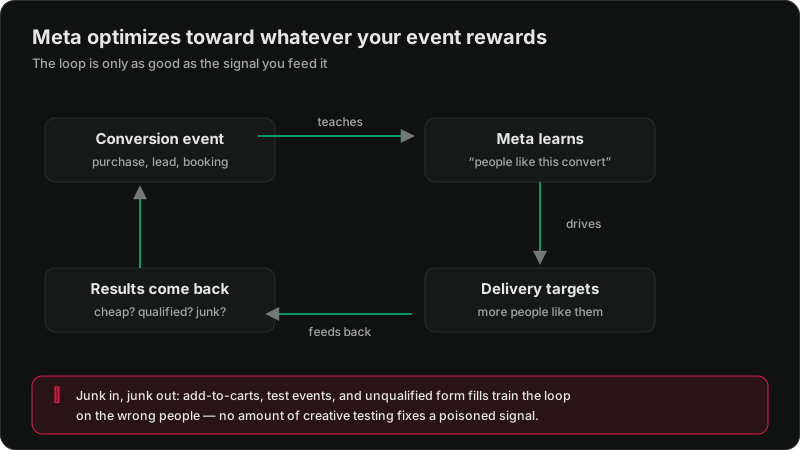
Meta's delivery system is a feedback loop. It finds more people like the ones who triggered your conversion event. If the event is wrong, noisy, or duplicated, the loop learns the wrong lesson — and no amount of creative testing fixes a poisoned signal.
1. Which event are campaigns optimizing toward?
Purchase or qualified lead — good. Add to cart, landing page view, or engagement on a sales campaign — that's the account training Meta to find window shoppers. It's the first thing I check and the most common root cause I find.
2. Is CAPI set up, and is deduplication working?
Browser pixel alone loses a meaningful share of events. Check Events Manager for both browser and server events with matching event IDs. Duplicated events (no dedup) are as bad as missing ones — they overcount and mislead both you and the algorithm. Full setup in the Meta conversion tracking and CAPI guide.
3. What is the event match quality score?
Under "Good" in Events Manager means Meta can't connect conversions to people, which weakens both optimization and reporting. Usually fixable by sending more customer parameters through CAPI.
4. Do purchase values reach Meta correctly?
Spot-check five recent purchase events against real orders. Wrong or missing values make value optimization and ROAS reporting meaningless.
5. Are test events and junk events polluting the account?
Staging-site pixels, developer test purchases, duplicate Lead events from multi-step forms. All of it feeds the loop.
6. For lead gen: does quality flow back to Meta?
If every form-fill counts equally, Meta optimizes for form-fillers. CRM integration or conversion leads optimization teaches it the difference between a tire-kicker and a booked client. Evaluate whether the revised signal improves qualified-lead cost and downstream sales over a suitable comparison period.
Part 2: Account structure (checks 7–11)
7. Count active ad sets vs weekly conversions.
Each ad set needs roughly 50 conversions a week to exit learning. Ten ad sets on a budget producing 60 total weekly purchases means nothing ever stabilizes. Consolidation is the most boring and most effective fix in Meta advertising.
8. Is there a structure, or an archaeology site?
Forty paused campaigns, three naming conventions, and duplicated audiences means the account has been panic-managed. The history still matters — Meta uses account-level learnings — but the active structure should be explainable in one sentence.
9. Audience overlap.
Multiple ad sets bidding on near-identical audiences compete against each other. Check the overlap tool for anything above ~30% between active ad sets.
10. Does retargeting get its own credit check?
A retargeting ad set with 8x ROAS at high frequency isn't finding customers; it's standing between your existing demand and the checkout. Its budget share should reflect that.
11. Advantage+ vs manual: has anyone actually tested?
Advantage+ Shopping often wins for ecommerce — but "often" isn't "always," and accounts that never ran the comparison are guessing. See the Advantage+ Shopping guide.
Part 3: Creative (checks 12–16)
12. How old are the top-spending ads?
Sort active ads by spend, check launch dates. Ads carrying most of the budget for 4+ months with rising frequency are usually the whole explanation for slow decline. My diagnosis process for this: why Facebook ads stop working.
13. What's the real creative testing cadence?
Not "do you test" — everyone says yes. How many genuinely new concepts (not recolored variants) entered the account in the last 60 days? Fewer than 4–6 means the account is coasting on old winners.
14. Is there concept diversity?
Five ads that are all polished product shots is one concept tested five times. A healthy mix spans UGC, founder-to-camera, problem-first hooks, social proof, and offer-led ads. Frameworks in Facebook ad copywriting frameworks.
15. Do the hooks survive three seconds?
Watch the top video ads with the sound off. If nothing happens in the first three seconds that would stop a thumb, the view metrics will already show it.
16. Does the ad promise match the landing page?
Click your own ads on mobile. Wrong product page, slow load, or a headline that drops the ad's promise — this is where "Meta problem" turns out to be a landing page problem.
Part 4: Economics and reporting (checks 17–19)
17. Does anyone know the target CPA — derived from margin, not vibes?
Contribution margin per order, or lead value times close rate. Without this number, "is ₱900 per purchase good?" has no answer, and neither does any scaling decision.
18. Meta-reported revenue vs actual revenue.
Compare 30 days of Meta-attributed purchases against your store or CRM. Meta over-credits itself, especially on retargeting-heavy accounts. You're not looking for a perfect match — you're looking for whether the gap is stable enough to steer by.
19. Frequency and reach trends over 90 days.
Same audience, rising frequency, flat reach: the account is re-buying the same people at increasing cost. That pattern demands new creative or genuinely broader delivery, not budget changes.
Part 5: Hygiene (checks 20–21)
20. Account and asset ownership.
Business Manager, pixel, page, domain, catalog — owned by you, or by a previous agency? Recovering hostage assets is painful. Verify before anything else.
21. Policy health.
Rejected-ad pile-ups and restricted statuses limit delivery quietly. Healthcare, wellness, and finance accounts need this checked every audit.
Scoring it
Related reading:

Written by
Vince Servidad
PPC & Creative Strategist
I manage Google Ads and Meta Ads for ecommerce, healthcare, SaaS, events and nonprofits, with creative strategy, Shopify development and conversion tracking.