Tools
How to Become a Virtual Assistant (2026): A Realistic Roadmap — and Who Should Skip It
Generalists compete on price and get replaced. Specialists compete on fit and get referred. A 90-day roadmap, the honest disqualifiers, and what the recruitment posts leave out.

PPC & Creative Strategist
Most "how to become a VA" advice ends at "make an Upwork profile and apply to 50 jobs a day." That's how you end up doing data entry for $3/hour against 400 other applicants.
The VAs who do well — the ones with two steady clients and a full night's sleep — tend to do something different. They pick one job to be good at before they go looking for anyone to pay for it.
But before the method, the part nobody selling a VA course will tell you: this work genuinely doesn't suit everyone, and the people it doesn't suit usually find out eight months in, after they've turned down a stable job. So we're starting there.
TL;DR
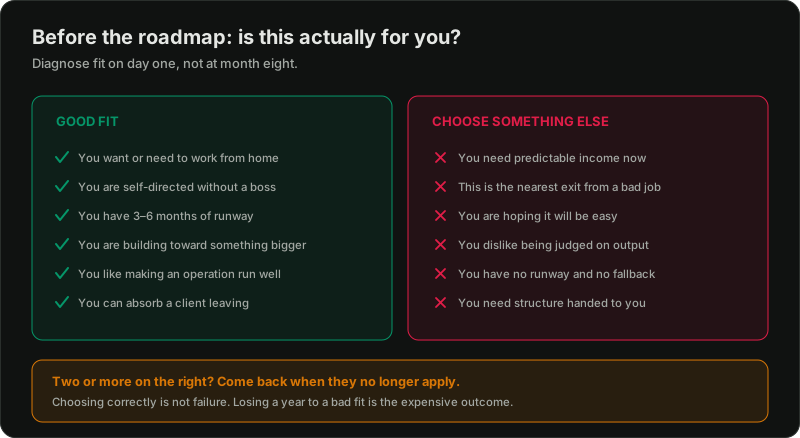
Honest first. This work suits you if you're comfortable being un-managed, can tolerate income that moves month to month, and can absorb a client disappearing.
It suits you badly if you need structure handed to you, need predictable pay, or are quietly hoping it feels easier than an office job. It usually doesn't.
If you're still in:
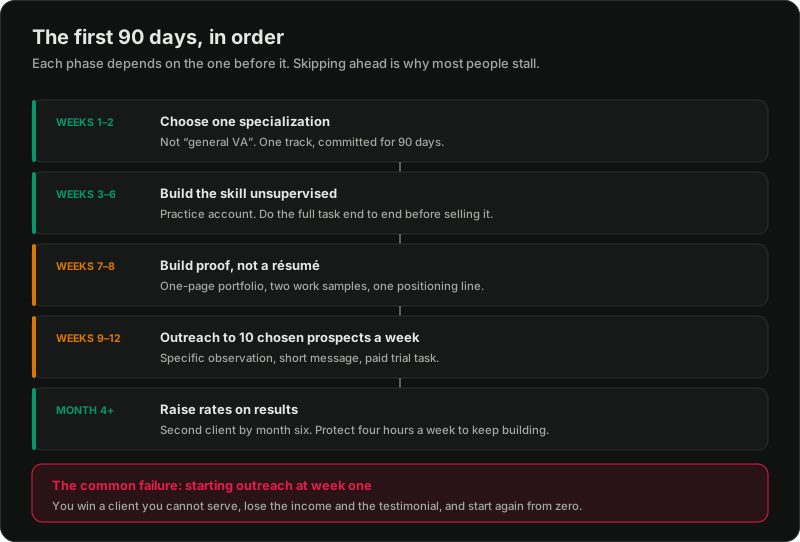
Realistic first client: ₱18K–₱30K/month part-time. Month 12 with two to three clients: ₱60K–₱120K/month. A lot of people who start this stop within the first year, and that's usually not a character flaw — it's a fit problem they could have diagnosed on day one.
The honest part: VA work is not for everyone
The recruitment posts sell freedom. What you're actually signing up for is running a one-person business where you are also the entire product. Those are very different jobs.
1. You lose the structure, and nobody replaces it
No supervisor. No shift bell. No colleague noticing you've gone quiet.
If you've only worked where someone else set the priorities, the first month alone is disorienting.
Some people find it liberating. Others discover structure was the thing holding their output together.
2. Your income moves, and bad months arrive without warning
A client restructures. Peak season ends. A founder runs out of runway.
If that client was most of your income, most of your income is gone on two weeks' notice.
That's normal here, not a disaster. But if your household needs the same number on the same date, that mismatch grinds you down long before the work does.
3. No 13th month, no HMO, no SSS employer share, no paid leave
You fund all of it yourself.
A ₱35K VA retainer is not equivalent to a ₱35K job. Do the subtraction before you compare offers.
4. The timezone question is real
Most of the best-paying clients are US-based. That often means starting at 9pm or 10pm PH time.
People manage it for a year or two. Very few manage it for five without something giving — sleep, health, or the relationships that happen in the evening.
Not willing to work nights? Say so now and target AU, NZ, Singapore, or Middle East clients instead. Smaller pool, liveable hours.
5. It gets lonely in a way that sneaks up
No lunch break with anyone. No small talk. Nobody who saw you handle the difficult week.
Isolation drives people out of remote work more often than the money does. Plan for it before it becomes the reason you quit.
6. You'll be managed by people who are bad at managing
Many clients hiring their first VA have never managed anyone.
Briefs will be vague. Feedback arrives late and blunt. Priorities change mid-task.
Part of the job is building the structure they didn't. That's a real skill — and it's tiring before it becomes one.
When VA work is a genuinely good fit
When to choose something else instead
Be honest here — choosing correctly is not failure, and I would rather you skip this than lose a year to it:
If two or more of those describe you right now, close this tab and come back when they don't. That's a real recommendation, not a disclaimer.
What a virtual assistant actually does in 2026
A VA is a remote contractor who owns a recurring part of someone's business so the owner can stop touching it.
The old definition — inbox, calendar, travel booking — still exists, but it's the most crowded and lowest-paid end of the market, and it's the part AI tools eat first. The work that's growing is narrower and more technical:
You are paid for a business owner not having to think about something anymore. The more expensive the thing you take off their plate, the more you get paid.
What a normal day actually looks like
For a part-time e-commerce VA on a US client, roughly:
Around four hours. The fifth hour is usually the one nobody scoped, and how you handle that hour decides whether this job stays sustainable.
The AI question, answered honestly
You should factor this in, because it changes which specialization is worth your 90 days.
Shrinking: pure transcription, basic data entry, simple copy-paste research, first-draft social captions, generic email replies. These are being absorbed by tools clients already pay for. Building a career on them in 2026 is building on sand.
Holding or growing: anything requiring judgment, accountability, or access. Deciding which customer complaint gets escalated. Chasing a supplier who's gone quiet. Owning a returns queue end to end so the owner never sees it. Keeping a CRM honest. Being the person who notices something broke.
The practical read: AI makes the task faster, so clients stop paying for execution and start paying for ownership.
"I'll do the tasks you send me" competes with a subscription.
"I own your returns queue and you'll never think about it again" doesn't.
The part that matters most if you are starting now
Read that shrinking list again, because there is a second implication and it is not comfortable.
Those tasks were the on-ramp.
Basic research, data entry, simple admin — that is how people with no track record used to land a first client. Low stakes, low skill bar, someone would take a chance on you. You learned the business from inside it and moved up.
That rung is being pulled up. The ceiling is rising and the floor is disappearing, and those are not the same story — the first is good news for people already established, the second is a problem specifically for you.
What it changes, practically:
This is the strongest argument in the whole article for picking one specialization and going deeper than feels necessary. It is also why the honest section above exists: the path in is genuinely narrower than it was, and pretending otherwise would not help you.
The one decision that sets your ceiling
Everything else in this method is execution. This part is the actual strategy.
A general VA competes on price. A specialist VA competes on fit.
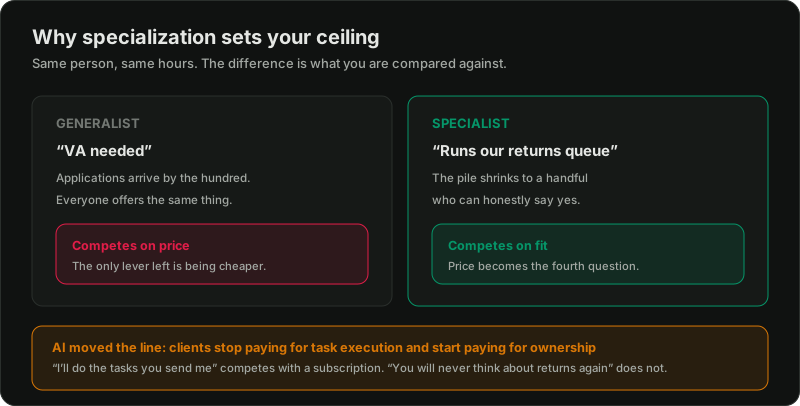
Post "VA needed" and the applications arrive by the hundred. The only way to stand out in that pile is to be cheaper.
Need "someone who can run our Shopify returns queue and keep the supplier sheet current"? The pile shrinks to a handful who can honestly say yes. Price becomes the fourth question, not the first.
Same person. Same hours. A materially better rate, because you are no longer interchangeable.
How to pick your specialization
Score each candidate skill on three things:
1. Can you get competent in 4–6 weeks of real practice? Klaviyo email builds, yes. Bookkeeping to BIR-filing standard, no — that's a longer road.
2. Does it touch money or the owner's time? Order handling, lead follow-up, and inbox triage do. Formatting slide decks does not.
3. Would you be fine doing it three hours a day for two years? Be honest here. Rate growth comes from repetition.
Pick the one that scores highest and commit for 90 days. Switching every three weeks is why most people are still at ₱15K after a year.
The four tracks, with what "good" looks like
| Track | Entry difficulty | Typical ceiling | AI exposure | Good means |
|---|---|---|---|---|
| Executive support | Low | ₱55K | Medium | The owner stops checking whether you did it |
| E-commerce ops | Medium | ₱80K | Low | Returns and orders never reach the owner's desk |
| Marketing support | Medium | ₱90K | Medium | You ship the flow without a brief being written |
| Bookkeeping / finance ops | High | ₱120K | Low | Books close on time, every month, unprompted |
The high-ceiling tracks are harder to enter. That's the entire reason their ceiling is high.
When to stay general instead
One case only: you've never worked in a business and genuinely don't know what you like.
Then take one broad role for three to six months. Treat it as paid discovery. Note which tasks you didn't mind, and specialize out of it.
Deliberate, time-boxed, with an exit date. That's different from drifting.
Step 1: Build the skill before you sell it (weeks 3–6)
You need to be able to do the task once, unsupervised, before you charge for it. Not certified — capable.
Set up your own practice environment:
Free training that's actually worth the hours: HubSpot Academy, Google Digital Garage, Shopify Compass, Klaviyo Academy, Meta Blueprint. Certificates alone convince nobody — the work you produced while earning them is the point.
Done means: you completed the full task end to end, you can explain your choices, and you have a screenshot or file to show.
The setup you actually need
Don't over-buy before you have income:
Client logins deserve a specific note: use a password manager, turn on 2FA, and never share credentials over chat. Getting this wrong once ends a relationship permanently.
Step 2: Build proof, not a résumé (weeks 7–8)
Clients hiring remote help have been burned before. They're not reading your résumé — they're looking for a reason to believe you'll still be responsive in week six.
Three things, that's all:
1. A one-page portfolio. Free Notion page or Google Doc, public link. Structure:
2. A clear positioning line. "Shopify e-commerce VA — product uploads, order handling, and customer service for stores doing 100+ orders a month." Not "hardworking and detail-oriented VA seeking opportunities."
3. A tidy public profile. LinkedIn or OnlineJobs.ph, headline matching your positioning line, photo, and the portfolio link. One profile done properly beats five half-filled ones.
Step 3: Outreach that gets replies (weeks 9–12)
Ten well-chosen prospects a week beats fifty applications. The spray approach fails because every message is obviously a template, and the ones actually hiring can tell.
Where the clients are
The message that works
Short, specific, and about them:
Hi [Name] — I noticed your store's returns page still points to a Gmail address. That usually means returns are landing in your personal inbox.
I handle returns queues and customer service for Shopify stores — set up the templates, clear the backlog, keep response time under 4 hours.
Two samples here: [link]. Worth a 15-minute call this week?
Why it works: one observation that proves you looked, one sentence on what you do, proof, one small ask. No life story, no "I am writing to express my interest."
The discovery call
Fifteen to twenty minutes. You are qualifying them as much as they're qualifying you.
Five questions:
That last one surfaces the timezone reality before either of you is committed.
Clients to walk away from
Turning down a bad first client is hard when you have no income. It is still cheaper than the four months you'll spend inside one.
Step 4: Price so you can survive month six
| Stage | Experience | Monthly retainer (part-time) | Hourly equivalent |
|---|---|---|---|
| Entry, specialized | 0–6 months | ₱18K–₱30K | ₱190–₱330 |
| Competent | 6–18 months | ₱30K–₱55K | ₱330–₱600 |
| Senior / niche | 18 months+ | ₱55K–₱120K | ₱600–₱1,300+ |
These are indicative ranges for direct-to-owner work, not survey data — check current listings on OnlineJobs.ph and in the VA communities before you set your own number. Work routed through an agency generally pays less for the same task, since the agency takes a margin.
Three rules:
1. Charge a monthly retainer, not hourly. Hourly punishes you for getting faster, and getting faster is the whole point. Fixed scope, fixed fee, fixed hours per week.
2. Never quote below ₱18K for specialized work, even as your first client. A ₱12K rate doesn't read as "good value" to a business owner — it reads as "will disappear in a month."
3. Raise rates on results, not tenure. "Response time went from two days to four hours and returns complaints dropped" earns a raise. "It's been a year" doesn't.
Bill in USD where you can. International clients generally pay well above PH local rates for the same work, and they're used to hiring contractors.
Getting paid without losing a chunk to fees
Agree the payment method before the first invoice, not after.
The trap: hiding inside busy
Here's the failure mode that costs more than any pricing mistake.
You land a client. You're grateful. So you say yes to everything.
The extra task. The weekend message. The "quick favour" that takes four hours.
Your hours creep from 20 to 45. Your effective rate quietly halves. And because you're buried, you stop building the skill that would let you charge more.
Eighteen months later you're exhausted, still on the same rate, and your entire income depends on one person who could restructure tomorrow.
The escape is not working harder. It is:
Being busy feels like progress. It isn't, if the rate never moves.
Common mistakes
Applying before you can do the work. You'll get one client, fail them, and lose both the income and the testimonial.
Free trial work. It filters for the clients you want least.
No contract. Get scope, rate, payment terms, and notice period in writing. A simple document you both sign is fine — this is the single cheapest protection you have.
Ignoring the tax side. Sort out registration and receipts early rather than untangling it in year two.
One client forever. Concentration risk. Build the second one before you need it.
Undercharging out of politeness. Business owners aren't offended by fair rates. They're relieved by reliability.
Treating a rough first month as proof you can't do this. The first month is uniformly bad for everyone. Judge fit at month three, on evidence, not at week two on feelings.
Realistic 12-month trajectory
Slower than the ₱100K-in-90-days posts promise. Considerably more likely to still be true in year two.
Questions people actually ask
Do I need a degree? No. Clients ask for work samples, not diplomas. Bookkeeping is the exception where credentials genuinely help.
Do I need experience to start? You need demonstrated capability, which is not the same thing. That's what weeks 3–8 are for.
Can I do this alongside a full-time job? Yes, and for most people it's the correct sequence. Take a client at 10 hours a week, keep the salary, leave when the freelance income covers your baseline for three consecutive months.
Is OnlineJobs.ph or Upwork better? OnlineJobs.ph for a faster first client at a lower rate. Upwork if you're already specialized. LinkedIn and referrals for the rates worth staying for.
What if I try and it doesn't work out? Then you spent three months learning Shopify, Klaviyo, or CRM operations, which are employable skills on their own. The downside here is genuinely capped, as long as you didn't quit a job to do it.
Start here this week
If the honest section didn't put you off, pick your specialization today and write it down as one sentence: who you help, with what. Then open the practice account.
If the honest section did put you off — that was the point of including it. Better now than eight months in.
Related reading:

Written by
Vince Servidad
PPC & Creative Strategist
I manage Google Ads and Meta Ads for ecommerce, healthcare, SaaS, events and nonprofits, with creative strategy, Shopify development and conversion tracking.