Home Services
Local Services Ads vs Google Search for Trades: Which Gets the Job
LSAs sit above everything, charge per lead, and need screening. Search gives you control and reach. For most trades the answer is both — but only if you know which one each job type belongs in.

PPC & Creative Strategist
Google uses the Google Verified badge for eligible Local Services advertisers. Availability and verification requirements depend on category and location.
For a home services business in a market where Local Services Ads are available, the top of the results page has three layers: LSAs with the Google Guarantee badge, then standard Search ads, then the map pack.
Most trades businesses run one of the first two and ignore the other. That's usually leaving money on the table, because they don't compete for the same thing.
TL;DR
What LSAs actually are
Local Services Ads appear at the very top of results for service queries, with the Google Verified badge. You are billed per lead — a call or message — rather than per click. Ranking depends on proximity, review score and volume, responsiveness, business hours, and whether you're accepting the job types requested.
To run them you complete a verification process: background checks, licence and insurance verification, the specifics varying by country and trade.
Availability is the first question. LSAs are not available in every market or for every trade, and coverage changes. Check what applies to your country and service category before building a plan around them — that's a five-minute check that prevents a wasted strategy.
Where each one wins
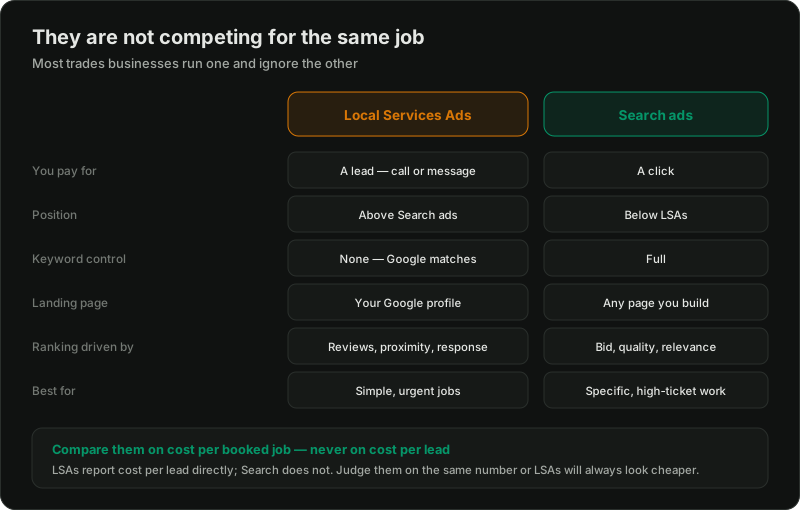
| Local Services Ads | Search ads | |
|---|---|---|
| You pay for | A lead (call/message) | A click |
| Position | Above Search ads | Below LSAs |
| Keyword control | None — Google matches | Full |
| Landing page | Your Google profile | Any page you build |
| Ad copy | Minimal | Full control |
| Ranking driven by | Reviews, proximity, responsiveness | Bid, quality, relevance |
| Best for | Simple, urgent, "who's available" | Specific, considered, high-ticket |
| Dispute bad leads | Yes | No |
LSAs are strong when the customer doesn't care which specific business, just that someone reputable comes out. Blocked drain. Broken aircon. Lock-out. The badge does the trust work and there's no landing page to build.
Search is strong when the job is specific and considered. "Colorbond roof replacement cost", "10kW solar system with battery", "heritage window restoration". Those need a real landing page explaining scope, price ranges, warranty, and process — none of which LSAs let you provide. Search also captures research-stage queries LSAs won't match to at all.
Which maps almost exactly onto the emergency vs planned split: LSAs skew emergency, Search covers both but is essential for planned.
Running both without wasting money
Don't judge them on the same metric. LSAs report cost per lead directly. Search reports cost per click, and you have to build up to cost per booked job. Compare them on cost per booked job, or you'll wrongly conclude LSAs are cheaper.
Expect some overlap. You may appear in both for the same query. That's usually fine — combined visibility raises total share — but watch whether Search volume drops when LSAs ramp, and judge the pair together.
Work the LSA levers, because they're not bid levers:
Keep Search for what LSAs can't do: brand defence, competitor terms, high-ticket specifics, research-stage queries, and anything needing a real landing page.
Budget split, practically
There's no universal ratio, but a workable starting point for a trades business with both available:
1. Fund LSAs to the volume of simple urgent work you can actually service. They deliver ready-to-book calls; the constraint is crew capacity, not budget appetite.
2. Fund Search for your high-ticket lines at the ceiling from cost per booked job. This is where the margin is and where LSAs give you no control.
3. Review by service line monthly, not channel-total. You'll often find LSAs win repairs and Search wins replacements — which tells you exactly where to move money.
The measurement catch
LSA leads mostly arrive as phone calls, which means the same problem as everywhere else in trades: if you're not qualifying and tracking calls, you can't tell a booked roof from a wrong number. Both channels report a "lead" and only one paid for itself.
Get call tracking and outcome tagging in place before you try to arbitrate between the two channels. Without it, the comparison isn't real.
Want the split worked out?
Which channel suits which of your service lines depends on job values, review position, service areas, and what you can actually staff. It's a genuinely account-specific answer.
Related reading:

Written by
Vince Servidad
PPC & Creative Strategist
I manage Google Ads and Meta Ads for ecommerce, healthcare, SaaS, events and nonprofits, with creative strategy, Shopify development and conversion tracking.