Home Services
Speed to Lead: Why Home Services Leads Don't Become Jobs
Most trades businesses with a lead problem don't have a lead problem. They have a response-time problem — and no amount of extra budget fixes a callback that happens the next morning.

PPC & Creative Strategist
The most common conversation I have with a trades business goes like this: "The leads are rubbish. We need better ones."
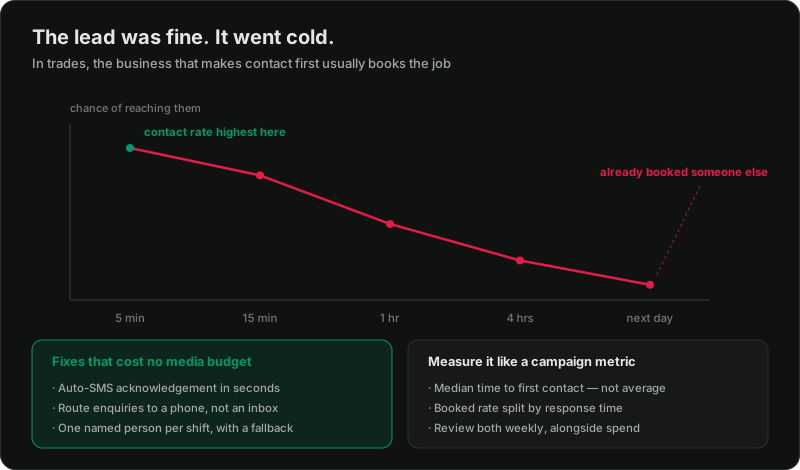
Then we look at the leads, and they're fine. Real people, right service area, real jobs. What actually happened is that the enquiry came in at 10:40am, someone rang back at 4:15pm, and by then the customer had already booked whoever answered first.
The lead wasn't bad. It was cold by the time anyone touched it.
This is the highest-leverage fix in home services PPC, and it isn't in the ad account at all.
TL;DR
Why trades is worse than other categories
Most people requesting a quote for urgent or semi-urgent work contact several businesses. They're not waiting for you specifically; they're waiting for someone competent to call back.
That makes it a race. And unlike ecommerce — where an abandoned cart can be recovered by email days later — a booked trades job is gone. There's no remarketing your way back into a roof that someone else is already installing.
The compounding part: the first business to make contact often gets to shape the job. They frame the scope, set the price expectation, and book the site visit. Everyone calling later is quoting against an anchor someone else set.
What "fast" actually means
Aim for under 5 minutes for emergency and high-ticket enquiries. Under an hour is the floor for anything else.
That sounds aggressive until you consider the alternative: paying premium CPCs for high-intent clicks and then converting a fraction of them because nobody rang back before lunch.
Realistic targets by type:
| Enquiry type | Target first contact |
|---|---|
| Emergency call (missed) | Call back within 2 minutes |
| High-ticket quote request | Within 5 minutes |
| Planned / research-stage form | Within 1 hour, business hours |
| After-hours form | Auto-acknowledge instantly, human by 9am |
Fixing it without hiring anyone
1. Auto-acknowledge instantly. An automatic SMS within seconds — "Thanks, this is Jake at [business]. I'll call you within 15 minutes" — buys you time and tells them they're in a queue with a real person. This alone recovers a lot, and it's a one-time setup.
2. Route to a phone, not an inbox. Form submissions that land only in email get checked when someone happens to check email. Push them as SMS or a call to whoever is on duty.
3. Give one person the job. "Whoever sees it" means nobody. A named person per shift, with a fallback.
4. Answer the phone, or use a service. In trades, a missed call is a missed job. If you can't cover the hours, either use an answering service or schedule the campaign off during those hours — don't pay for clicks that ring out.
5. Call back missed calls automatically. Any missed call from an ad number should trigger an immediate callback task. These are your highest-intent contacts and the easiest to recover.
6. Shorten the form. Name, phone, suburb, job type. Every extra field costs you completions, and you can collect the rest on the call. More on this in the lead-gen landing page checklist.
Measure it as a campaign metric
If you're not measuring time to first contact, you cannot manage it — and you'll keep blaming the media.
Track, per enquiry: time received → time first contacted → outcome. Then review two numbers weekly:
Most CRMs will do this. A spreadsheet will too.
What this does to your media
Here's why it's a PPC issue and not just an ops one.
If your booked rate from enquiries rises from 20% to 30% because you started answering faster, your maximum cost per enquiry rises by half — same ceiling maths as in cost per booked job. You can now outbid competitors who haven't fixed their intake, on the same margin.
Then it compounds: feeding booked jobs back through offline conversion imports teaches bidding which enquiries convert — and enquiries convert more when they're answered fast. Better intake produces better data produces better bidding.
Response time is upstream of your entire media efficiency. That's why I look at it before touching campaigns.
The uncomfortable version
Sometimes the honest answer to "we need more leads" is "you can't handle the ones you have." A business generating 60 enquiries and contacting 25 of them promptly does not have a media problem — and spending more would make it worse, not better.
That's usually not what someone wants to hear when they came for campaign management. It is, reliably, the cheapest thing to fix.
Want the whole funnel looked at?
Diagnosing whether the constraint is media, measurement, or intake is the first thing I do on a trades account — because getting that order wrong wastes months.
Related reading:

Written by
Vince Servidad
PPC & Creative Strategist
I manage Google Ads and Meta Ads for ecommerce, healthcare, SaaS, events and nonprofits, with creative strategy, Shopify development and conversion tracking.