Home Services
Emergency vs Planned Demand: The Split Most Trades Accounts Are Missing
A burst pipe at midnight and a kitchen remodel researched over six weeks are two different businesses sharing one ad account. Run them together and the urgent work quietly pays for the browsing.

PPC & Creative Strategist
Two people search for a plumber.
The first has water coming through a ceiling at 11pm. They will call the first business that answers, barely read the ad, and not compare prices.
The second is planning a bathroom renovation for autumn. They will research for six weeks, get three quotes, and read every review you have.
Most trades accounts run both through the same campaign, with the same bids, the same ad copy, the same landing page, and the same hours. That is the single most common structural mistake I find in home services, and it costs money in both directions.
TL;DR
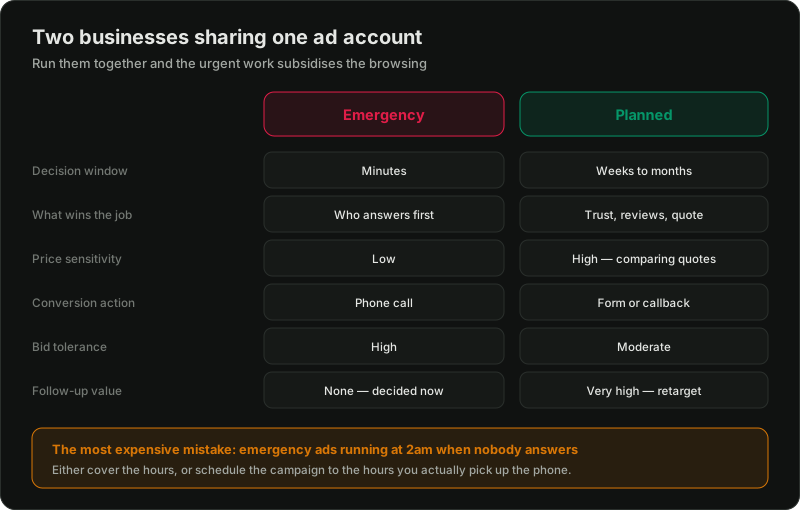
How the two behave differently
| Emergency | Planned | |
|---|---|---|
| Decision window | Minutes | Weeks to months |
| Device | Mobile, often at night | Desktop and mobile, business hours |
| What wins it | Who answers first | Trust, reviews, quote quality |
| Price sensitivity | Low | High — comparing quotes |
| Conversion action | Phone call | Form, quote request, callback |
| Bid tolerance | High | Moderate |
| Follow-up value | None — decided in one session | Very high |
Blend those and you get the worst of both: bids too low to win the emergency auction, ad copy too urgent for the planner, and a landing page that serves neither.
Splitting the keywords
The intent is usually visible in the query.
Emergency signals: "emergency", "24 hour", "near me now", "same day", "burst", "leaking", "no power", "not working", "urgent", "tonight".
Planned signals: "cost", "price", "quote", "best", "compare", "how much", "installation", "replacement", "reviews", "worth it", model and brand names.
Two campaigns, hard-separated with negatives so they cannot cannibalise each other. Query drift is real — check the search terms weekly, per the weekly routine.
What each campaign should actually do
Emergency
Planned
The hours problem, specifically
Worth its own section because it's where I see the most waste.
An emergency campaign running 24/7 into a business that answers 8am–5pm is buying the most expensive clicks in the account and sending them to voicemail. The people clicking at 2am are the highest-intent traffic you will ever get — and you are converting zero of them while paying peak-urgency prices.
Two acceptable answers: cover the hours (answering service, on-call rota), or schedule the campaign to your actual answering hours. What isn't acceptable is paying for 2am clicks nobody picks up.
Check this first. It's a five-minute audit and it frequently frees up a meaningful chunk of budget.
Measuring them separately
They need different conversion actions, or your reporting collapses back into mush.
Report cost per booked job for each separately. You'll usually find emergency has a much higher cost per click and a much *lower* cost per booked job — which is exactly the insight the blended account was hiding.
The seasonal overlay
Both move with the weather, but not identically. Emergency spikes with storms, heatwaves, and cold snaps — sharp and unpredictable. Planned demand builds ahead of a season and is forecastable.
That means planned campaigns should be paced with a ramp (see budget pacing), while emergency campaigns need budget headroom so they aren't capped on exactly the day a storm doubles demand. A budget that ran out at 9am during the one week of the year that mattered is a costly way to learn this.
Want the split built properly?
The separation itself is a day's work. The judgement is in where the intent line sits for *your* services, and whether your answering coverage can support the emergency side at all.
Related reading:

Written by
Vince Servidad
PPC & Creative Strategist
I manage Google Ads and Meta Ads for ecommerce, healthcare, SaaS, events and nonprofits, with creative strategy, Shopify development and conversion tracking.