Shopify
The Shopify Trial: A Day-by-Day Plan to Actually Launch
Most people spend the trial picking colours and end it with a beautiful store that has never taken an order. Here's a schedule that gets you to a real first sale instead.

PPC & Creative Strategist
The Shopify trial is not a period for evaluating Shopify. You already know it works — millions of stores run on it.
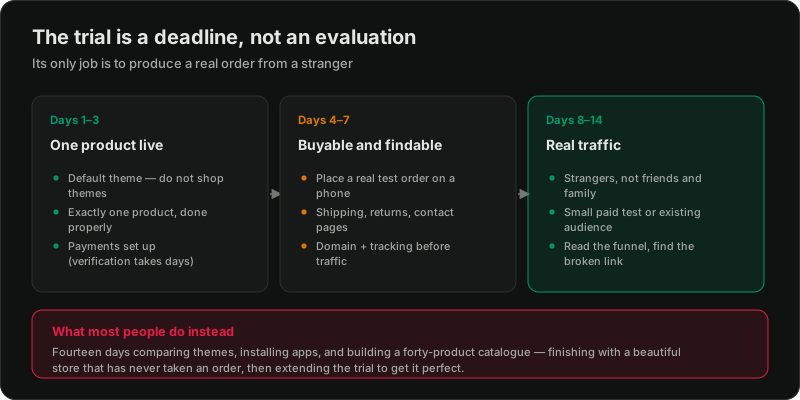
The trial is a deadline. Its only useful function is to force you to find out whether your thing sells, and the only way to learn that is to put it in front of strangers and see if any of them pay you.
Most people don't. They spend the trial choosing fonts, comparing themes, installing apps, and finish it with a beautiful store that has never processed an order. Then they extend, and do it again.
Here's the schedule I'd give someone starting today.
Disclosure: the Shopify links below are affiliate links. If you start a trial through one I earn a commission at no extra cost to you. I build on Shopify for clients — the recommendation isn't contingent on the link.
TL;DR
Before day one: the only real decision
What are you selling, and why would someone buy it from you rather than the incumbent?
If you can't answer the second half in a sentence, no amount of store-building will rescue it. This is the single most common reason first stores fail, and it fails long before anything technical.
You don't need a perfect answer. You need a specific one. "Cheaper" is specific. "Ships same-day in Metro Manila" is specific. "Better quality" is not.
Days 1–3: get one product live
Start the trial (here's the link) and give yourself three days for this. Not more.
Pick the default theme. Yes, really. Shopify's free themes convert perfectly well and you have zero evidence about what your customers respond to. Changing the theme later is a couple of hours. Deciding now costs you days and buys nothing.
Add exactly one product. Your best one. A catalogue of forty with placeholder descriptions teaches you nothing; one product done properly teaches you whether the offer works.
Do that one properly:
The structure that works is in product page best practices.
Set up payments. In PH this usually means a local gateway — the options are here. Do it now, because it's the step most likely to hit an unexpected verification delay, and finding that out on day twelve is how trials get wasted.
Days 4–7: make it buyable and findable
Place a real test order yourself. All the way through, with a real payment method, then refund it. An astonishing number of stores launch with a checkout that silently fails on mobile. Test on a phone, not just your laptop.
Write the three pages that build trust: shipping and delivery times, returns, and a contact page with a real way to reach you. These are not admin — for a store nobody has heard of, they *are* the trust. Returns and refunds.
Set up your domain. A custom domain costs little and a .myshopify.com URL costs you conversions.
Install tracking before you have traffic, not after. Retrofitting analytics means throwing away your first and most interesting week of data. Ecommerce tracking setup.
Install nothing else. No apps yet. You don't have a problem for them to solve.
Days 8–14: get real traffic
This is the half everyone skips, and it's the only half that answers the question.
Friends and family don't count. They buy out of kindness and tell you what you want to hear. You need strangers.
Realistic options in two weeks:
Then read the funnel honestly:
| What you see | What it means |
|---|---|
| No traffic | Distribution problem — nothing else is testable yet |
| Traffic, no add-to-carts | The offer or the product page isn't landing |
| Add-to-carts, no checkouts | Shipping cost or trust — cart optimisation |
| Checkouts, no completions | Payment or checkout friction — checkout optimisation |
Each of those is a different problem with a different fix. Getting to the point where you know *which one you have* is a genuinely successful trial, even with zero sales.
What not to do
Don't install apps. Not one. You have no data and every app is a monthly cost plus a speed penalty — speed matters.
Don't buy a premium theme. Later, when you know what your customers do.
Don't build the full catalogue. One product tests the offer. Forty tests your stamina.
Don't spend days on the logo. Nobody has ever declined to buy over a logo.
Don't extend the trial to "get it perfect." Perfect is what people do instead of finding out.
If the fortnight produces nothing
That's a result, not a failure — and it's cheap compared to finding out six months in.
Ask which link broke. No traffic is a distribution problem and has nothing to do with your store. Traffic that doesn't convert is an offer problem, and the offer is fixable. Both are more useful to know than another week of theme adjustments.
Start the clock
If you've got a product and an answer to "why buy from you," start the trial and put the fourteen days in your calendar as three blocks. The deadline is the point.
Related reading:

Written by
Vince Servidad
PPC & Creative Strategist
I manage Google Ads and Meta Ads for ecommerce, healthcare, SaaS, events and nonprofits, with creative strategy, Shopify development and conversion tracking.