E-commerce
How to Test Your Landing Page When You Don't Have Much Traffic
A/B testing needs more traffic than most businesses have — running one below the volume floor just produces confident nonsense. Here's how to actually improve a page at 500, 5,000, or 20,000 visits a month.

PPC & Creative Strategist
"Just A/B test it" is the standard advice for improving a landing page. It's also wrong for most businesses, because a proper A/B test needs far more traffic than they have. Run one anyway and you'll declare a winner off random noise, then scale a change that does nothing — or hurts.
The good news: you can meaningfully improve a page at any traffic level. You just have to match the *method* to your volume. Here's how.
TL;DR
Why the floor exists
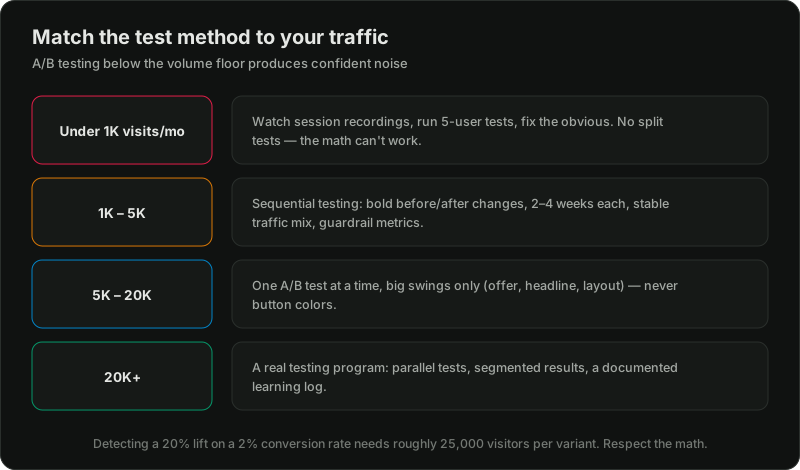
Statistical significance needs a sample big enough to separate a real effect from luck. The lower your conversion rate and the smaller the improvement, the more traffic you need. A rough rule: to reliably detect a 20% relative lift on a 2% base conversion rate, you need on the order of 25,000 visitors per variant — 50,000 total. A store doing 3,000 visits a month would wait most of a year for one result, by which time the season, offer, and traffic mix have all changed and invalidated it.
So below serious volume, the honest move isn't a worse A/B test — it's a different method.
Under 1,000 visits/month: research, don't split-test
You can't test statistically, so learn qualitatively and fix the obvious.
1,000–5,000/month: sequential testing with guardrails
Not enough for clean A/B tests, but enough to compare periods — if you're careful.
Sequential testing is weaker evidence than a true A/B test — external factors, not your change, might be moving the number. But paired with big swings and honest guardrails, it beats guessing.
5,000–20,000/month: one real A/B test at a time
Now you can run legitimate split tests, but only for changes big enough to resolve before your patience or your season runs out.
20,000+/month: a real testing program
At this volume you can run a proper practice: parallel tests where they don't overlap, results segmented by device and source, and — most valuable — a documented learning log. What you *learn* about your customers compounds across tests far more than any single winner. This is where dedicated tools and structured CRO earn their keep.
The mistake at every level
The universal error is testing changes too small for your traffic to detect. A business with 2,000 monthly visits agonizing over button color could have rewritten the entire offer and *seen* the difference. Low traffic doesn't forbid improvement — it forbids *timid* improvement. Make bold changes and read them with the right method.
And whatever the level, measure correctly: if tracking is broken, every test lies to you regardless of sample size. Verify it first — why the platform numbers don't match covers the common traps.
Related reading:

Written by
Vince Servidad
PPC & Creative Strategist
I manage Google Ads and Meta Ads for ecommerce, healthcare, SaaS, events and nonprofits, with creative strategy, Shopify development and conversion tracking.