Shopify
Shopify vs Shopee, Lazada and TikTok Shop: The Honest Comparison
Marketplaces bring the traffic and take the margin, the customer, and the pricing power. An own store gives all three back and hands you the traffic problem. Most Philippine sellers should run both — in a specific order.

PPC & Creative Strategist
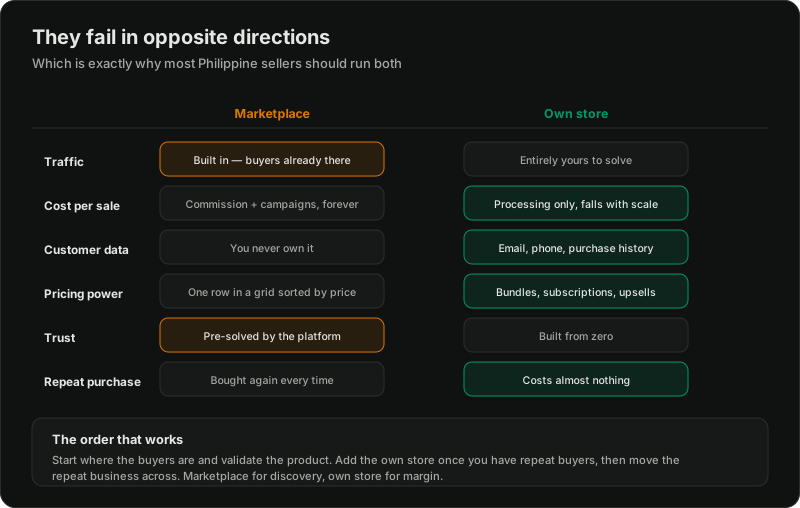
This gets framed as a choice, and for most Philippine sellers it isn't one. The two models fail in opposite directions, which is precisely why running both works.
But the *order* matters enormously, and getting it backwards is expensive.
Disclosure: the Shopify links here are affiliate links — if you start a store through one I earn a commission at no extra cost to you. I'm not neutral in the sense that I build on Shopify for clients, and I've tried to be straight below about where marketplaces genuinely win.
TL;DR
What marketplaces are genuinely good at
Being fair about this first, because a lot of "own your store" writing is dishonest about it.
They have the buyers. Enormous numbers of Filipinos open Shopee or Lazada with intent to purchase and no particular brand in mind. That is a real, valuable thing that your new store does not have and will not have for a long time.
Trust is pre-solved. Buyers trust the platform's escrow, returns, and dispute process. A store nobody has heard of has to earn all of that from scratch.
Logistics and payments are handled. Integrated couriers, COD, and payment methods people already use. COD in particular is hard to replicate well and still matters a lot in PH.
Zero fixed cost to start. No monthly fee. You pay when you sell.
For a first-time seller with no audience, that combination is genuinely hard to beat, and I'd rather someone start there than launch an own store into silence.
What marketplaces cost you
Commission on every sale, forever. Plus payment fees, plus — in practice — the campaign and voucher participation that visibility effectively requires. The all-in take is usually well above the headline rate, and it never falls as you scale. It's a permanent tax on your margin.
You don't own the customer. No email list, no phone number, no ability to contact a past buyer. Every repeat purchase is bought again through the platform. On your own store, a repeat customer costs approximately nothing, which is the whole basis of LTV economics.
No pricing power. You're one row in a grid sorted by price, next to sellers who will go lower. Price is the main lever the format gives you, which is a race with a predictable ending.
No brand. Buyers remember the platform, not you. "I bought it on Shopee" is what they'll say.
Rules can change without you. Fee structures, algorithm changes, category rules, suspensions. Your entire business sits on someone else's terms of service.
What an own store gives back
Margin. No commission. You still pay processing and platform costs — the real numbers here — but they're smaller and, unlike commission, they fall as a share of revenue as you grow.
The customer. Email, phone, purchase history. This is the asset. It's what makes email flows the highest-return thing most stores do.
Pricing and merchandising control. Bundles, subscriptions, upsells, your own promotional logic — bundles, upsells.
Real tracking. Your own pixel, your own conversion data, your own attribution. You cannot run serious paid acquisition without this — marketplaces don't give you the data that makes ads work.
An asset that's worth something. A store with its own traffic, list, and repeat customers can be sold. A marketplace shop mostly cannot.
What an own store costs you
Being equally honest in this direction: you inherit the traffic problem entirely.
Nobody arrives by accident. Every visitor comes from ads you paid for, content you made, or an audience you built. That's a real, ongoing cost and it's the reason most first stores fail — not the platform, not the theme.
You also rebuild trust from zero, arrange your own logistics, and pay a fixed monthly cost whether you sell anything or not.
The order that works
If you have no audience and no traffic plan: start on the marketplaces. Learn whether the product sells at all. Marketplace demand is the cheapest product-validation available, and validating on your own store means paying for traffic to answer a question the marketplace answers free.
Once you have repeat buyers and some idea of your numbers: open the own store alongside. Not instead — alongside. Keep the marketplace running as your discovery channel.
Then move the repeat business over deliberately. This is the part people miss. Marketplace rules restrict directing buyers off-platform, so respect them — but a package insert, a warranty registration, and a genuinely better direct experience are legitimate and effective. Your first purchase can stay a marketplace acquisition; your second doesn't have to be.
The end state most successful PH sellers land on: marketplaces for discovery and new customers, own store for repeat purchase, bundles, and margin. The marketplace is a customer-acquisition channel with a known cost, and the own store is where the profit lives.
A rough way to decide
| Situation | Where I'd start |
|---|---|
| No audience, unproven product | Marketplace |
| Proven product, repeat buyers | Add own store |
| Strong social audience already | Own store first |
| High-margin or bundled products | Own store weighted |
| Commodity products competing on price | Marketplace-weighted |
| Building something you intend to sell | Own store, early |
The one-line version
Marketplaces rent you distribution and charge margin for it. An own store gives you the margin and hands you the distribution bill. Run both, and use the cheap traffic to build an asset you own.
Ready to open the store side?
If you're at the point where marketplace repeat business justifies it, starting a Shopify store is a fortnight of work — the plan is in the trial schedule.
Related reading:

Written by
Vince Servidad
PPC & Creative Strategist
I manage Google Ads and Meta Ads for ecommerce, healthcare, SaaS, events and nonprofits, with creative strategy, Shopify development and conversion tracking.