Google Ads
B2B PPC When the Sales Cycle Is Six Months Long
B2B paid campaigns fail on a measurement problem, not a targeting one: the conversion that matters happens months after the click, so bidding optimises toward whatever it can see instead. Here's how to close that loop.

PPC & Creative Strategist
Ecommerce PPC has a tight feedback loop. Click today, purchase today, bidding learns tonight.
B2B doesn't. Someone downloads a guide in January, takes a call in March, and signs in June. By then the platform has long since decided what a good click looks like — based on the only thing it could see, which was the download.
That gap is why B2B campaigns so often produce impressive lead volume and disappointing pipeline. It isn't a targeting problem. It's a feedback problem, and it's fixable.
TL;DR
Why the default setup misleads
Set up conversion tracking the normal way and your one conversion is "form submitted." Smart Bidding maximises it. It gets very good at finding people who submit forms.
The people most likely to fill in a form are not the people most likely to buy a £40K annual contract. They're students, competitors, consultants, and the mildly curious. Your cost per lead falls. Your cost per *customer* rises. The dashboard shows the first number.
This is the same failure as lead-gen generally, just stretched over months — see getting leads but no clients.
The fix: send the pipeline back
Your CRM already knows which leads progressed. The job is getting that knowledge back to the ad platforms.
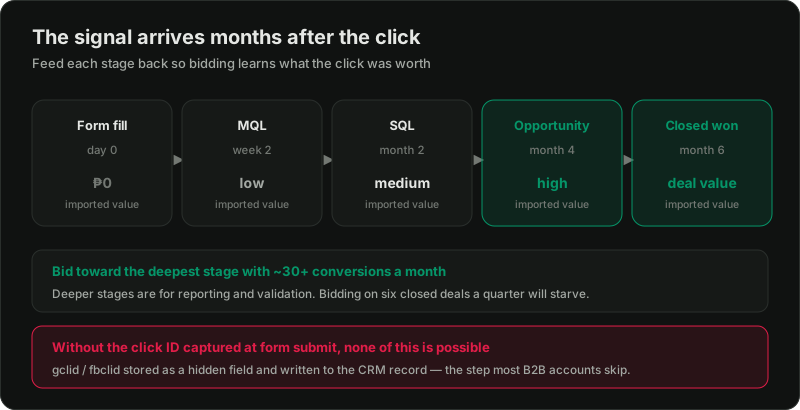
1. Capture the click identifier at form submit. gclid for Google, fbclid/_fbc for Meta, stored as a hidden field on the form and written to the CRM record. Without this, nothing downstream is possible. This single step is the one most B2B accounts are missing.
2. Define stages and values. Not all progress is equal:
| Stage | Imported value | What it teaches |
|---|---|---|
| Form fill | ₱0 or nominal | volume only |
| Marketing qualified | low | rough fit |
| Sales qualified | medium | real intent |
| Opportunity | high | genuine pipeline |
| Closed won | actual deal value | the truth |
3. Import on a schedule. Weekly is usually enough. Each import updates the platform's picture of what that original click was worth. The mechanics are in offline conversion tracking.
4. Bid toward the deepest stage with enough volume. If you only close six deals a quarter, bidding on closed-won will starve. Bid on the deepest stage that produces roughly 30+ conversions a month, and use the deeper stages for reporting and validation.
Bridging the volume gap
Long cycles create a real tension: the signal that matters is sparse and late.
Use a proxy conversion. Find the earliest action that correlates with becoming a real opportunity — a demo request, a pricing-page visit followed by a form, a specific high-intent page view. Optimise toward that while feeding the real outcomes back for correction.
Weight your forms. A "contact sales" form and a "download the PDF" form are not the same event. Give them different conversion actions and different values from day one.
Watch lead quality weekly, not conversion volume. The number to review is the share of leads reaching SQL, split by campaign and keyword. That's what tells you a campaign is degrading before the pipeline does.
Structure and targeting notes
Report by cohort, not by month
Monthly reporting breaks in B2B: this month's spend and this month's revenue have nothing to do with each other.
Report by click cohort instead. "Leads generated in January: 120. Of those, 34 reached SQL, 11 became opportunities, 4 closed for ₱2.1M against ₱240K spent." That's a sentence a finance director can act on. "Cost per lead was ₱2,000" isn't.
It also means being honest that recent months are incomplete. A cohort three weeks old will look terrible; that's expected, not a warning sign.
The uncomfortable requirement
All of this depends on the CRM being maintained. If deals aren't stage-updated, or the click ID isn't captured, none of it works and you're back to optimising on form fills.
Getting that plumbing right — click ID capture, stage mapping, import cadence — is usually a week of work that changes what the whole channel can do. It's part of my performance marketing strategy and conversion tracking work.
Related reading:

Written by
Vince Servidad
PPC & Creative Strategist
I manage Google Ads and Meta Ads for ecommerce, healthcare, SaaS, events and nonprofits, with creative strategy, Shopify development and conversion tracking.