B2B SaaS
Brand, Competitor, and Category Keywords: The Three SaaS Budgets
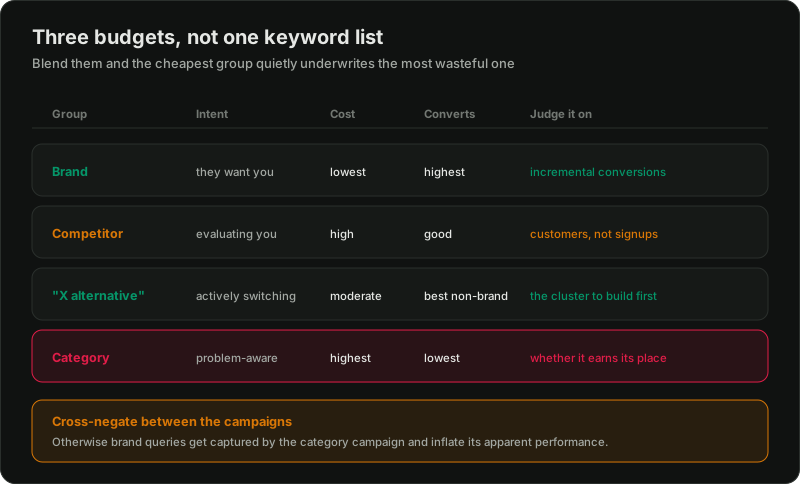
SaaS search demand splits into three groups with completely different costs, conversion rates, and honest definitions of success. Running them in one campaign guarantees the cheapest one gets the credit.

PPC & Creative Strategist
Almost every SaaS search account I audit has the same structural problem. Brand terms, competitor terms, and category terms are mixed together — sometimes in one campaign, often under one target CPA — and the account is judged on the blended result.
That blend is not a compromise. It's a hiding place. Brand terms convert cheaply and prop up the average, category terms burn budget quietly underneath, and nobody can tell which is happening because the summary row looks acceptable.
These are three different budgets with three different jobs. They should be built, bid, and judged separately.
TL;DR
1. Brand terms
People searching your product name. Cheapest clicks, highest conversion rate, and the terms that make an account look brilliant.
The honest question is how much of that would you have got anyway through the organic result you already rank first for.
Arguments for bidding on your own brand:
Arguments against, or at least for restraint:
The resolution is a test, not an opinion: pause brand for a week or two and watch total conversions, not just paid ones. If total volume holds, you were largely buying your own traffic. If it drops, you were defending something real. Run it long enough to clear noise, and not during a launch or a spike.
Either way: brand goes in its own campaign, always. It is the single highest-leverage structural change in most SaaS accounts, because it stops one cheap keyword group from underwriting everything else.
2. Competitor terms
Bidding on rival product names. Expensive, uncomfortable, and often the best-converting non-brand traffic in the account.
What to expect going in: low Quality Score — your landing page genuinely isn't about their brand, and Google prices that in — plus low click-through rates, high costs per click, and a fair chance they start bidding on yours in return. Price all of this in rather than treating it as a failure.
On trademarks: in most markets you may generally *bid on* a competitor's trademarked name, but using it *in your ad copy* is a different matter and platforms act on complaints. Rules vary by jurisdiction and change. This is a question for whoever handles your legal, not for your PPC manager — mine is not a legal opinion.
The part that decides whether this works: send the traffic to a real comparison page. Someone searching a competitor's name is mid-evaluation and wants to know how you differ. A homepage answers nothing and wastes an expensive click.
A comparison page that works is specific and fair — an honest feature comparison including things they do better, clear positioning on who each product suits, pricing transparency, and migration detail if switching is the realistic action. Fairness is not a moral flourish here; a page that reads as a hatchet job loses the sophisticated evaluators you were trying to reach.
How to judge it: on incremental customers, not cost per lead. Competitor terms should be allowed a worse CPA than brand, because they're reaching people actively evaluating alternatives — demand you cannot generate any other way.
The high-CPC discipline in managing expensive clicks applies directly here.
The "alternative to" cluster
The most under-exploited terms in SaaS. Queries like *"[competitor] alternative"*, *"[competitor] vs [competitor]"*, *"best [category] software"*, and *"[competitor] pricing"* signal someone who has already decided the incumbent isn't right and is actively shopping.
They're cheaper than head competitor terms, convert better, and are frequently left entirely to organic. If you build one thing out of this article, build this cluster.
3. Category terms
Generic descriptions of what you do: "project management software", "help desk tool", "email automation platform".
They feel like the obvious keywords and they are usually where SaaS budgets go to die. Everyone bids on them, so they're expensive; the intent is early, so conversion is poor; and the traffic includes students, researchers, and people who'll evaluate for six months.
They still have a role — this is genuine top-of-funnel demand and some of it converts. But:
If budget is tight, this is the group to cut first. It's also the group most likely to be defended on the grounds that it "must" work because it describes the product exactly.
Structuring it
Four campaigns, minimum:
| Campaign | Expectation | Judge on |
|---|---|---|
| Brand | Very low CPA | Incremental conversions |
| Competitor | Moderate–high CPA | Customers, not signups |
| Category — specific | Moderate CPA | Pipeline over a longer window |
| Category — broad | Highest CPA | Whether it earns its place at all |
Each gets its own budget and target. Cross-negate between them so brand queries can't be captured by the category campaign and inflate its apparent performance — a specific and very common way accounts flatter themselves.
What this looks like when it's working
Brand sits quietly with a low CPA and you know from a real test what it's contributing. Competitor terms cost more per customer than brand and you're comfortable with that, because you can see the customers. The specific category cluster is your growth lever. The broad category campaign is on a short leash and gets reviewed rather than assumed.
Most importantly, no group can hide behind another, which means every budget decision is made on something you can actually see.
Want the structure reviewed?
Most SaaS accounts I audit are running brand blended with everything else, no comparison pages behind competitor terms, and a broad category campaign nobody has questioned in a year. All three are same-week fixes with visible effects.
Related reading:

Written by
Vince Servidad
PPC & Creative Strategist
I manage Google Ads and Meta Ads for ecommerce, healthcare, SaaS, events and nonprofits, with creative strategy, Shopify development and conversion tracking.