B2B SaaS
CAC Payback: Why SaaS Can't Be Managed on Cost Per Acquisition
In ecommerce the revenue arrives with the conversion. In SaaS it arrives monthly for years, or it stops in week three. A target CPA that ignores that difference is a guess wearing a number.

PPC & Creative Strategist
Every other category I write about has one thing in common: the money arrives at roughly the same time as the conversion. Someone buys a product, signs a matter, books a job. Revenue lands, and you can judge the click that caused it.
SaaS breaks that. A customer acquired today might pay you $80 a month for four years, or $80 once and then cancel. Both look identical in Google Ads. Both cost the same to acquire. One is the best money you ever spent and the other is a loss you won't notice for a quarter.
This is why "what's a good CPA for SaaS?" has no answer, and why the question is a symptom rather than a starting point.
TL;DR
The three numbers, in the order they matter
1. Gross-margin-adjusted LTV. Not lifetime revenue. Lifetime *contribution*. If a customer pays $100/month and it costs you $20/month to serve them — hosting, support, payment fees, third-party APIs — you have $80 to work with, not $100.
The usual form:
LTV = ARPA × gross margin ÷ monthly churn rate
2. LTV:CAC ratio. The widely cited healthy target is around 3:1. Treat it as a sanity check, not a law. A 3:1 ratio on a twelve-month payback is a very different business from a 3:1 ratio on a thirty-month payback, and only one of them is fundable.
3. Payback period. How many months of contribution margin it takes to recover the acquisition cost.
Payback months = CAC ÷ (ARPA × gross margin)
Of the three, payback is the one that kills companies. LTV:CAC tells you whether the business works eventually. Payback tells you whether you can survive getting there. A company with excellent LTV:CAC and an eighteen-month payback is one funding delay away from having to stop spending.
Worked example
A self-serve product on a $80/month plan:
| Input | Value |
|---|---|
| ARPA | $80/month |
| Gross margin | 80% |
| Monthly contribution | $64 |
| Monthly churn | 3% |
| Average lifetime | ~33 months |
| LTV | $2,112 |
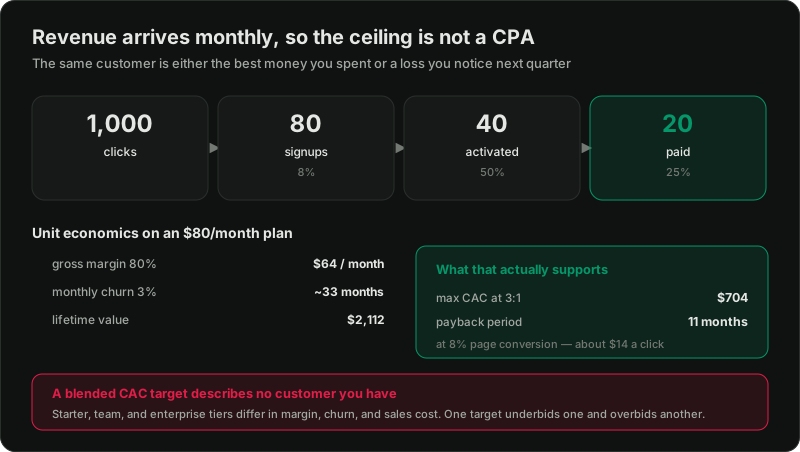
At a 3:1 target, your maximum CAC is about $704. That's a payback period of 11 months ($704 ÷ $64) — tight but workable for most funded companies, uncomfortable for a bootstrapped one.
Now push it down the funnel:
Fourteen dollars a click. Most people managing this account would have capped bids at $4 because $14 "felt expensive," and in doing so bought themselves out of the auction entirely.
That's the real value of doing this arithmetic: not permission to spend more, but knowing which number you're allowed to be uncomfortable with.
Why blended numbers destroy SaaS accounts
Most SaaS businesses have plan tiers, and the tiers do not behave alike. A $29 starter plan, a $200 team plan, and a $2,000 enterprise contract have different margins, different churn, and different sales costs — the enterprise deal probably involves a salesperson, which is a real acquisition cost that never appears in Google Ads.
Blend them into one CAC target and you get the worst of both:
The fix is unglamorous and effective: separate campaigns by the plan tier they realistically produce, and give each its own target. If you can't tell which keywords bring which tier, that's the first thing to instrument, not a reason to keep blending.
Same failure mode as legal case values in cost per signed case — different industry, identical maths.
Making bidding see any of this
None of the above matters if the ad platforms are still optimising toward free signups.
1. Capture the click ID at signup — gclid for Google, fbclid for Meta — and store it on the account record. Everything downstream depends on this one step.
2. Define your activation event and track it. A signup that never activates is not a lead, it's a row in a database. Covered in trial-to-paid.
3. Import paid conversions with real plan values as offline conversions, weekly. Method in offline conversion tracking.
4. Bid toward the deepest stage that has enough volume. If you close eight enterprise deals a quarter, bidding on closed-won will starve the algorithm — bid on qualified demos and use closed-won for validation. The reasoning is the same as long B2B sales cycles.
Where SaaS teams get this wrong
Using revenue LTV instead of contribution LTV. The single most common error, and it inflates your ceiling by whatever your cost of service is. It feels like a rounding difference until you're spending against it.
Ignoring the sales cost in sales-assisted tiers. If a deal needs three calls from an AE, that's part of CAC. Marketing CAC and blended CAC are different numbers and mixing them makes both useless.
Assuming churn is stable. Early-stage churn estimates are usually optimistic, and churn varies sharply by acquisition source — which is its own problem, covered in churn as a paid acquisition problem.
Treating the 3:1 ratio as a target rather than a floor to clear. It's a heuristic from a different era of capital costs. Your payback constraint is more binding and more honest.
Forgetting expansion revenue. If accounts reliably expand, your effective LTV is higher than a static ARPA suggests. Worth modelling — but only once you have real cohort data, not as a hopeful multiplier on a spreadsheet.
Want your ceiling calculated?
The arithmetic here is genuinely simple. Getting trustworthy inputs out of a SaaS business — where churn is defined three different ways depending on who you ask, and gross margin quietly excludes the support team — is the actual work, and it decides whether the channel is viable before you spend anything proving it.
Related reading:

Written by
Vince Servidad
PPC & Creative Strategist
I manage Google Ads and Meta Ads for ecommerce, healthcare, SaaS, events and nonprofits, with creative strategy, Shopify development and conversion tracking.