B2B SaaS
Churn Is a Paid Acquisition Problem
Churn gets treated as something product and customer success own. But retention sets your maximum bid, and some acquisition channels reliably deliver customers who were never going to stay.

PPC & Creative Strategist
Churn is usually filed under product, or customer success, or onboarding. Somewhere else, anyway. The ads team acquires customers; keeping them is another department's number.
That division is convenient and wrong, in both directions.
It's wrong because retention determines what you're allowed to pay for a customer — so churn is an input to every bid you set. And it's wrong because acquisition decides *which* customers you get, and some sources reliably deliver people the product was never going to serve.
TL;DR
The arithmetic that makes this a media problem
From CAC payback, lifetime value is roughly ARPA × gross margin ÷ monthly churn.
Churn sits in the denominator, which is why small changes there move your ceiling more than almost anything you can do in the ad account.
Take a $100/month product at 80% gross margin — $80 monthly contribution:
| Monthly churn | Avg lifetime | LTV | Max CAC at 3:1 |
|---|---|---|---|
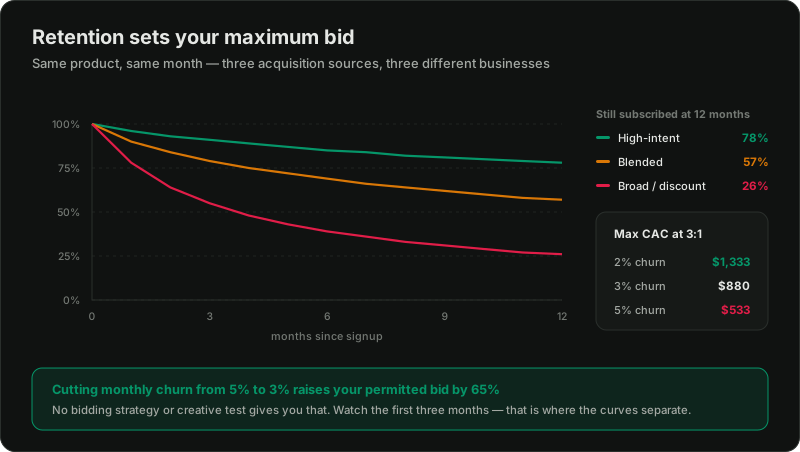
| 5% | 20 months | $1,600 | $533 |
| 4% | 25 months | $2,000 | $667 |
| 3% | 33 months | $2,640 | $880 |
| 2% | 50 months | $4,000 | $1,333 |
Going from 5% to 3% monthly churn raises your maximum CAC by 65%. Not your revenue — your permitted bid.
There is no bidding strategy, creative test, or landing page change that gives you a 65% cost advantage over your competition. Retention does, and it does it permanently.
This is the same compounding argument as legal intake and trial onboarding, and it's the strongest one in SaaS because the effect is multiplicative rather than additive.
Where acquisition actually causes churn
Wrong-fit targeting. Broad campaigns and loosely-targeted social reach people whose problem your product half-solves. They sign up, discover the gap, and leave. The campaign reports a conversion; the business gets three months of revenue and a support burden.
Discount-led acquisition. Aggressive introductory pricing attracts people who were buying the discount. Retention past the first renewal is reliably worse. If you run promotional offers, track those cohorts separately — the CAC looks great and the LTV usually doesn't.
Overclaiming in ad copy. Creative that oversells sets expectations the product can't meet. This one is genuinely a media problem: the copy is yours. It also tends to *improve* your click-through and conversion rates, which is exactly why it survives testing that only looks at the top of the funnel.
Wrong plan tier. Pushing everyone to a starter plan they'll outgrow — or an enterprise plan they can't justify — produces churn that looks like product failure and is really a positioning decision made in an ad group.
Competitor-switch traffic. Worth naming honestly: people who switched *to* you from a competitor demonstrably switch again. This traffic is still usually worth buying — it's some of the highest-intent demand available — but model it with a shorter expected lifetime rather than your blended average.
The report to build
Retention curves segmented by acquisition source. Simple to describe, rarely built, and it changes budget decisions immediately.
1. Tag every customer with acquisition source, campaign, and signup date — this is the same click-ID plumbing as offline conversion tracking.
2. Group by signup month cohort.
3. Plot percentage still subscribed at 1, 3, 6, and 12 months, by source.
4. Compare the curves.
What you're looking for is not the average — it's divergence in the first three months. A channel that loses a third of its customers by month three has a fundamentally different LTV to one that loses a tenth, even if their CAC is identical.
Then recompute your maximum CAC *per channel* using each channel's actual churn rather than a company-wide figure. Some channels will turn out to justify far higher bids than you're running. Others will turn out to be unprofitable at any bid, which is a genuinely useful thing to learn.
Give it time. You need at least six months of cohort data before the curves mean much, and you need enough volume per channel that you're not reading noise. If a channel produced eleven customers last quarter, its retention curve is a story, not a finding.
What to do with the answer
Bid down or exclude structurally poor-retention sources, even when their CAC looks attractive. Cheap acquisition of customers who leave is not a bargain; it's a slower way to lose the same money, with support costs attached.
Bid up on high-retention sources. This is the fun part. If your best channel produces customers who churn at 2% while your blended assumption was 4%, you've been underbidding by half on the traffic you most want.
Feed retention back into bidding values. If you can predict at signup — from plan, source, or company size — that a customer is worth $3,000 rather than $1,500, send *that* value as the conversion value. Bidding will find more of them.
Fix the copy where it overclaims. Cheapest available intervention, and it usually costs you a little conversion rate in exchange for a lot of lifetime.
The part nobody wants to own
Every argument above requires marketing to accept responsibility for something that happens months after their attribution window closes, and to voluntarily give up flattering CAC numbers in exchange for slower, truer ones.
That's a real organisational cost, and it's why this report so often doesn't get built despite everyone agreeing it should be. The teams that do build it end up with a bidding advantage their competitors can see the results of and not explain.
Want retention brought into the media decisions?
Most SaaS accounts I look at are optimised on a company-wide LTV assumption that no individual channel matches. Splitting it is usually a fortnight of plumbing and permanently changes which campaigns get funded.
Related reading:

Written by
Vince Servidad
PPC & Creative Strategist
I manage Google Ads and Meta Ads for ecommerce, healthcare, SaaS, events and nonprofits, with creative strategy, Shopify development and conversion tracking.