B2B SaaS
Trial-to-Paid: Why Your Cheapest Signups Cost the Most
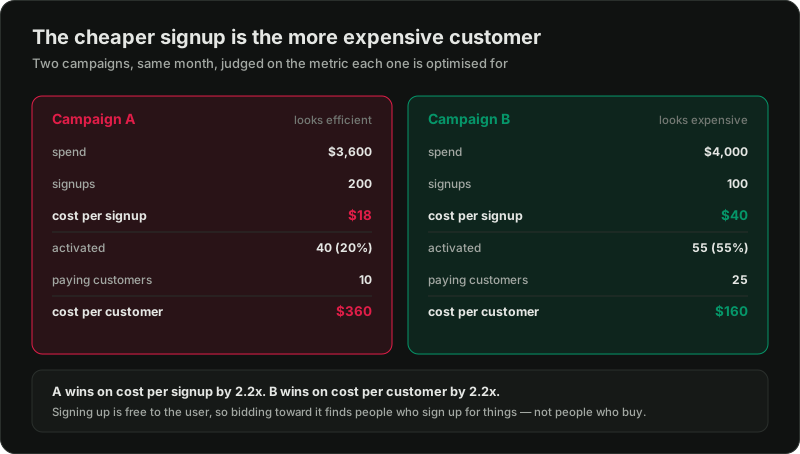
The campaign with the best cost per signup is frequently the campaign with the worst cost per customer. Signup is not a conversion — it's a request to be convinced, and most SaaS accounts bid as though it were the finish line.

PPC & Creative Strategist
Here is a pattern I've seen in nearly every SaaS account I've looked at.
One campaign has a signup cost well below the others. It gets praised in the monthly report, gets more budget, and gets held up as what the rest of the account should look like. Six weeks later, revenue hasn't moved.
The campaign was cheap because it was attracting people who sign up for things. Signing up is free. Signing up is not the behaviour you needed to buy.
TL;DR
Why signup is such a bad optimisation target
Smart Bidding is extremely good at finding more of whatever you tell it to find. Tell it to find signups and it will find the people most likely to sign up.
Those people are disproportionately: students, competitors doing research, developers who wanted the API docs, people who'll never reach the paywall, and anyone who has learned that a work email gets you past most trial gates. They are real humans doing reasonable things. They are not customers.
Meanwhile the campaign producing genuine buyers looks expensive, because serious evaluators are slower, more deliberate, and considerably rarer.
Optimise on signups long enough and the algorithm will systematically drain budget from the second group into the first. This is the same mechanism as lead quality in lead gen, sped up and made harder to see because the volume looks healthy the whole time.
Find your activation event
Activation is the moment a user does the thing that makes the product make sense to them. It's product-specific, and you cannot guess it — you have to find it in your data.
Practically: take users who converted to paid and users who churned during trial, and look for a behaviour that separates them early. Candidates usually look like:
The test is predictive power, not intuition. If 70% of users who invite a teammate convert and 8% of users who don't ever do, you've found it — and you've also just found the most valuable thing your onboarding emails could be pushing.
Two cautions. First, correlation isn't causation: people who were going to buy anyway may simply do more of everything. Forcing everyone through the action won't automatically convert them. Second, activation events drift as the product changes — revalidate every couple of quarters rather than trusting a definition someone wrote two years ago.
Even with those caveats, activation is a far better bidding signal than signup, because it's expensive to fake and cheap to measure.
The structure that actually works
The tension is real: activation is a better signal, but it arrives later and in smaller numbers. Smart Bidding needs volume to learn.
A workable arrangement:
1. Track all three stages — signup, activated, paid — as separate conversion actions with different values.
2. Bid on the deepest stage with enough volume. Rough guide: if you're getting fewer than ~30 of something per month per campaign, it's too sparse to bid on directly.
3. Feed the deeper stages back anyway, even when you're not bidding on them. They're what you judge the account on, and they're what you'll graduate to as volume grows.
4. Value the stages honestly. If 25% of activated trials become paid and a customer is worth $2,100 in gross-margin LTV, an activated trial is worth roughly $525. Use that number, not a made-up one.
Ceiling maths in CAC payback.
Credit card up front, or not
This decision changes what the word "trial" means in your reporting, so it needs to be a deliberate choice rather than an inherited default.
Card required produces far fewer trials, a much higher trial-to-paid rate, and a signal clean enough to bid on almost immediately. It also filters out genuine buyers who simply aren't ready to hand over a card to a product they haven't used.
No card produces a lot of trials, a much lower conversion rate, and a signal that needs activation layered on top before it's worth anything to a bidding algorithm.
Neither is correct in the abstract. What is incorrect is running no-card trials and then reporting trial volume as though it were pipeline.
Onboarding is part of the media buy
This is the argument that usually reframes the conversation with a founder.
Suppose your trial-to-paid rate goes from 20% to 25% — better onboarding emails, a clearer empty state, a nudge toward the activation event. Nothing about the ad account changed.
Your revenue per trial just rose by 25%, which means your maximum cost per trial rose by 25% too, at the same margin. You can now outbid every competitor whose onboarding is still where yours was.
In a category where everyone is bidding on the same twelve keywords, that's a structural advantage, and it compounds: better conversion produces more paying customers, which produces more conversion data, which produces better bidding.
It's the same shape as intake in legal and speed-to-lead in home services. The pattern holds across every category — the constraint is usually just downstream of where people are looking for it.
What to report
Kill the signup-count dashboard and replace it with, per campaign:
Report by signup cohort, not by calendar month. Judging July's spend on July's revenue makes no sense when the conversion takes five weeks; you'll fire good campaigns and promote bad ones.
The uncomfortable version
Sometimes the honest finding is that the campaigns are fine and the product's first-run experience is losing people who arrived ready to buy. That's not what anyone wants to hear when they hired someone to fix the ads.
I'd still rather say it in week two than spend a quarter optimising bids toward a funnel that leaks at the same point regardless.
Want the funnel looked at properly?
Working out whether the constraint is targeting, measurement, or onboarding is the first thing I do on a SaaS account, because getting that order wrong wastes an expensive quarter and usually produces a confident, wrong conclusion.
Related reading:

Written by
Vince Servidad
PPC & Creative Strategist
I manage Google Ads and Meta Ads for ecommerce, healthcare, SaaS, events and nonprofits, with creative strategy, Shopify development and conversion tracking.