B2B SaaS
The Buying Committee: When One Customer Looks Like Six Visitors
B2B software is bought by groups, but every ad platform measures individuals. The person who fills in the form is rarely the person who decided, and last-click reporting cannot see the difference.

PPC & Creative Strategist
A mid-market software purchase typically involves several people: whoever felt the problem, whoever will use the tool daily, someone technical checking it won't break anything, someone in security or procurement, and whoever signs.
Your ad account sees none of that. It sees six anonymous visitors, five of whom did nothing measurable, and one who filled in a form. It attributes the deal to that last person and quietly concludes the other five were wasted spend.
Then someone optimises the account on that conclusion.
TL;DR
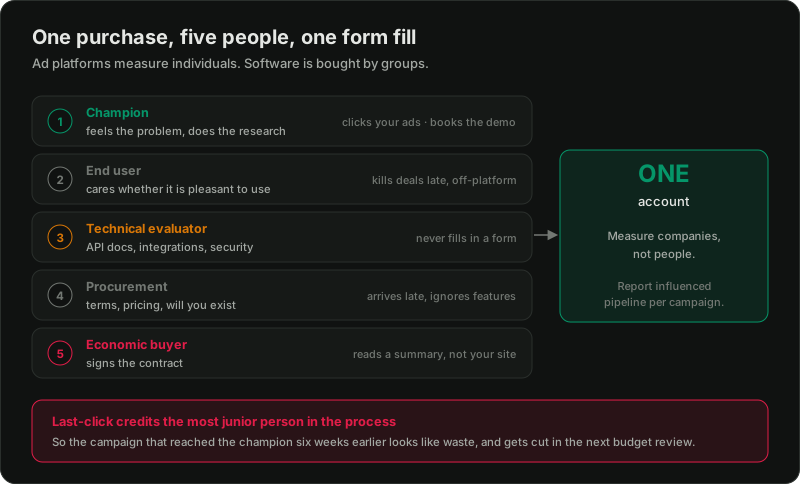
Who's actually in the room
Roles rather than job titles — one person often holds several, and in a small company one person may hold all of them:
The champion. Feels the pain, starts the search, and does most of the research. They will click your ads, read your comparison pages, and book the demo. They also have to sell you internally after you stop talking to them, which is the part most SaaS marketing forgets.
The end user. Cares about whether the thing is pleasant to use. Kills deals late by being unenthusiastic in a room you're not in.
The technical evaluator. Wants API docs, integration lists, security posture, data residency. Will never fill in a lead form. Will absolutely torpedo a deal on a missing integration.
Procurement or finance. Cares about contract terms, pricing predictability, and whether you'll still exist next year. Arrives late, uninterested in your feature set.
The economic buyer. Signs. Often has almost no contact with your marketing, and forms their view largely from a summary written by the champion.
What this breaks
Last-click attribution reads backwards. The demo request is frequently submitted by the most junior person in the process — sometimes an assistant. Attributing the deal to their final branded search hides the category search, six weeks earlier, that started everything.
Retargeting pools are contaminated. Someone who read your security documentation for eleven minutes and someone who bounced off the pricing page in nine seconds sit in the same audience unless you build them differently.
Lead scoring punishes the wrong signals. A technical evaluator who read three docs pages and never converted looks like a failure by every standard metric, and may be the reason you win.
Campaigns get cut for doing early work. A campaign reaching problem-aware researchers will show poor last-click numbers for months. It's often the one feeding everything else, and it's usually the first one paused in a budget review.
The measurement mechanics are in attribution models and why platform numbers don't match.
Measure at account level
The core shift: stop counting people and start counting companies.
1. Resolve leads to accounts in your CRM. Multiple contacts from one company are one opportunity. Most CRMs do this natively; many teams don't use it.
2. Track which campaigns touched an account at any point, not just the last one. Even a rough first-touch / last-touch pair beats last-click alone.
3. Report influenced pipeline per campaign — total value of opportunities the campaign touched — alongside last-click. Two numbers, both visible, neither pretending to be the whole truth.
4. Feed closed-won back at the account level with real contract values, via offline conversion imports.
You don't need enterprise attribution software for this. A click ID stored on the contact record, contacts resolved to accounts, and a weekly export gets you most of the value. The cadence fits inside a normal weekly routine.
Give each role something to arrive at
If several people evaluate you, sending all traffic to one page wastes most of the visits.
The champion needs a comparison page and an internal business case — an ROI calculator, a one-page summary they can forward. The most valuable asset you can build for a champion is something they can paste into an email to their boss. Very few SaaS sites have one.
The technical evaluator needs public docs, an integrations page, and a security page with real detail. Gating these is a mistake: you're not losing a lead by leaving them open, you're removing a reason to disqualify you. Nobody was going to fill in that form.
Procurement needs clear pricing, contract terms, and compliance documentation. Pricing pages that say "contact us" are a deliberate trade — accept that you're buying qualification at the cost of some evaluations ending before they begin.
The economic buyer needs outcomes and proof. Case studies with numbers, ideally from a recognisable peer.
Practical consequence for the media: run retargeting segmented by what people actually read, not one undifferentiated site-visitors pool. Someone who spent time in the docs should see integration and security messaging; someone who read the pricing page should see proof and case studies.
What to stop doing
Judging every campaign on last-click conversions. Some campaigns exist to reach people who will never convert directly and will decide whether you win.
Gating technical documentation. You are hiding the thing the evaluator needed behind a form they will never fill in.
One retargeting audience. Behaviour tells you which role you're talking to. Use it.
Reporting lead counts to a board. In a committee purchase, lead count is close to meaningless. Report accounts engaged and pipeline influenced.
The honest limits
Account-level measurement is harder than it sounds. People use personal emails. Companies have subsidiaries. Someone researches from home on a phone that never sees your CRM. Multi-touch models require assumptions you can't validate, which is why I'd rather show first-touch and last-touch side by side than a single confident model.
You will not get this perfect. You don't need to. You need to stop making decisions as though the last click were the whole story, because that error is large, systematic, and always points the same way: toward cutting the campaigns doing the early work.
Want the account looked at this way?
Check whether reports connect contacts from the same company and distinguish enquiries from useful opportunities. Evaluate any change over a period that fits the sales cycle.
Related reading:

Written by
Vince Servidad
PPC & Creative Strategist
I manage Google Ads and Meta Ads for ecommerce, healthcare, SaaS, events and nonprofits, with creative strategy, Shopify development and conversion tracking.