Legal
Cost Per Signed Case: Why Law Firm PPC Can't Be Managed on Cost Per Lead
Legal keywords are among the most expensive in search, and two enquiries from the same keyword can differ in value by an order of magnitude. Cost per lead cannot survive that spread.

PPC & Creative Strategist
Legal is the hardest category in paid search to manage badly and get away with. The clicks are among the most expensive anywhere in Google Ads, and the variance in what a matter is worth is enormous — two enquiries from the same keyword can differ in value by an order of magnitude.
Put those together and cost per lead becomes actively misleading. A campaign with a low cost per enquiry can be the one losing money, because it found the enquiries that were easy to capture and impossible to sign.
TL;DR
First, a scope note
Legal advertising is permitted in some jurisdictions and heavily restricted in others, with rules set by bar associations and professional conduct codes that vary by market and change over time.
In the Philippines, practitioners are substantially restricted from advertising under professional conduct rules — so this is generally a US and Australian conversation rather than a domestic one. Whatever your market, the rules are a question for your compliance counsel, not your marketer. What follows is the economics and measurement side only.
The four rates
1. Enquiry → qualified. Right practice area, right jurisdiction, viable matter, not a conflict, not someone who already has counsel. In legal this is brutal — broad campaigns routinely qualify well under half.
2. Qualified → consultation. Did they actually attend? Legal has a real no-show problem, and it correlates strongly with how fast you responded.
3. Consultation → signed. Your conversion rate as a firm. Most partners know this one.
4. Signed → fee collected. For contingency work especially, signed is not banked. Duration and realisation rate matter.
Worked example
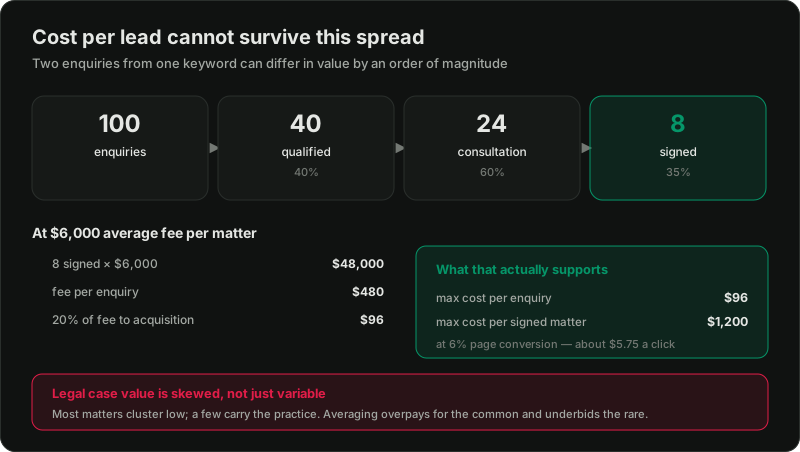
A firm running ads for a practice area where the average matter earns the firm $6,000 in fees:
| Step | Rate | From 100 enquiries |
|---|---|---|
| Enquiries | — | 100 |
| Qualified | 40% | 40 |
| Consultation attended | 60% | 24 |
| Signed | 35% | 8 |
If you're willing to spend 20% of fee revenue on acquisition, your maximum cost per enquiry is $96, and your maximum cost per signed matter is about $1,200.
Now the part that surprises people: at a 6% landing-page conversion rate, $96 per enquiry supports roughly $5.75 per click. That's a click cost most businesses would consider absurd, and in this practice area it's simply the price of doing business — the firms bidding $2 because it "feels high" are invisible in the auction.
Run the same maths on a practice area earning $800 a matter and paid search may not be viable at all. That's a genuinely useful answer, and it's better to have it before the budget than after.
Why blended averages break legal specifically
Legal case value doesn't just vary — it's often heavily skewed. A practice area can have most matters clustered low with a small number worth many multiples of the rest.
Averaging across that produces a number no matter actually equals, and it distorts in both directions: you overpay for the common small matters and underpay for the rare large ones that carry the practice.
Two consequences:
Making bidding see it
None of this works unless signed matters get back to the platforms.
1. Capture the click ID at enquiry — gclid for Google, stored on the matter record. Without this nothing downstream is possible.
2. Track calls, because most legal enquiries arrive by phone. Untracked, your measured cost per enquiry is fiction — see call tracking.
3. Import signed matters as offline conversions with real fee values, weekly. The method is in offline conversion tracking.
4. Bid toward the deepest stage with enough volume. If you sign six matters a quarter, bidding on signed will starve — bid on qualified consultations and use signed for validation. Same reasoning as long B2B sales cycles.
Where firms get this wrong
Counting enquiries as leads. An enquiry is not a lead until it's qualified. Reporting raw contact volume to partners sets expectations that collapse at the first review.
Ignoring intake. The largest leak in most legal accounts isn't the auction — it's what happens in the twenty minutes after someone calls. Covered in legal intake.
Treating all practice areas as one budget. They have different economics, urgency, and competition. Splitting them is usually the single highest-return restructure.
Forgetting fee realisation. Signed and paid are different numbers, especially on contingency.
Want your ceiling calculated?
The arithmetic is simple. Getting honest rates out of a firm — where enquiries arrive by phone, intake is spread across people, and matter values are skewed — is the real work, and it decides whether the channel is viable at all.
Related reading:

Written by
Vince Servidad
PPC & Creative Strategist
I manage Google Ads and Meta Ads for ecommerce, healthcare, SaaS, events and nonprofits, with creative strategy, Shopify development and conversion tracking.