Legal
Managing the Most Expensive Clicks in Google Ads
When a single click costs more than most businesses spend in a day, the usual optimisation habits stop applying. Here's what changes when every wasted query is real money.

PPC & Creative Strategist
In most accounts, a bad click costs a few pesos and you learn from it in aggregate. In legal, insurance, medical devices, restoration, and a handful of other categories, one bad click can cost more than a small business spends on ads in a day.
That single fact changes the job. Everything that's "hygiene" in a normal account becomes the entire discipline, and several habits that work fine at low CPCs become expensive at high ones.
TL;DR
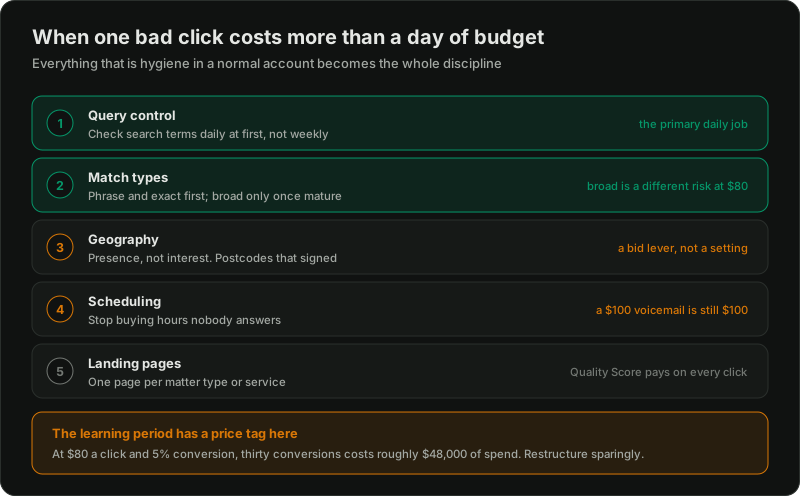
What changes at high CPC
One wasted click is a real loss
At $0.50, a hundred junk clicks is $50 and a shrug. At $80, ten junk clicks is $800 — a meaningful share of a monthly budget gone on queries that were never going to convert.
This is why negative keyword work stops being maintenance and becomes the primary daily activity for the first few weeks of any high-CPC account.
The learning period is genuinely expensive
Smart Bidding needs conversions to learn. At $80 a click and a 5% conversion rate, thirty conversions costs roughly $48,000 of spend.
Practical consequences:
Small percentage improvements are large absolute ones
A 10% improvement in conversion rate on a $50,000/month legal account is worth more than most entire small accounts. That justifies effort that would be over-engineering elsewhere: bespoke landing pages per matter type, call-recording review, proper offline conversion plumbing.
The controls that matter, in order
1. Query control
Check the search terms report daily for the first two to four weeks of any new high-CPC campaign, then weekly. Not because it's virtuous, but because a single un-negated term can burn thousands before a weekly review catches it.
Build negatives in layers:
Legal accounts specifically bleed on: "free", "pro bono", "how much do lawyers charge", "can I sue", "law school", competitor names you didn't intend, and — critically — the *other* side of the matter, where a firm acting for one party pays for clicks from the opposing one.
2. Match type discipline
Broad match plus Smart Bidding works well in many accounts. At $80 a click, the same setup can spend thousands exploring queries before it learns.
A workable sequence:
3. Geography, treated as a bid lever
For location-bound services, geographic precision is one of the strongest efficiency controls you have. Not just "which cities" — which suburbs and postcodes have historically produced signed matters or booked jobs.
Also: set location targeting to presence, not interest, unless you deliberately want people merely searching about a place. The default catches a lot of expensive irrelevance.
4. Scheduling against answering capacity
If a $100 click generates a call nobody picks up, you paid $100 for a voicemail.
Look at conversion rate by hour and by day, then stop buying the hours you can't answer. Same argument as emergency trades campaigns, with a bigger price tag attached.
5. Landing page relevance
Quality Score affects what you pay per click. At high CPCs a modest Quality Score improvement is worth real money on every click, every day — the mechanics are in Quality Score, and the speed side in landing page speed.
One page per matter type or service. A generic homepage receiving $80 clicks is an expensive way to be irrelevant.
Habits to unlearn
What actually justifies the price
High CPCs aren't irrational. Competitors bid that much because the matters or jobs are worth it. The question is never "is this click expensive" — it's "is this click expensive relative to what it's worth to me."
Which is why the economics come first. Without a defensible maximum cost per acquisition, you're either underbidding into invisibility or overbidding into losses, and you can't tell which.
Want the controls audited?
Most high-CPC accounts I audit are leaking on two or three query patterns that a proper negative structure would have caught, and buying hours nobody covers. Both are same-week fixes with immediate effect.
Related reading:

Written by
Vince Servidad
PPC & Creative Strategist
I manage Google Ads and Meta Ads for ecommerce, healthcare, SaaS, events and nonprofits, with creative strategy, Shopify development and conversion tracking.