E-commerce
Landing Page Speed for Paid Traffic: What Actually Costs You Money
You pay for every visitor who leaves before the page renders. Most speed advice optimises for a score rather than for that moment — here's what actually moves paid conversion, in priority order.

PPC & Creative Strategist
Speed matters differently for paid traffic than for organic. An organic visitor chose to come and will often wait. A paid visitor was interrupted mid-scroll, has no relationship with you, and will bounce without a second thought — and you paid for them either way.
Every one of those bounces is money spent on a visitor who never saw your offer. Which makes page speed a media efficiency issue, not a technical hygiene one.
Most speed advice sends you chasing a score. Here's what actually changes paid conversion, in the order worth doing it.
TL;DR
Measure the right thing
Chasing a perfect score is a trap — you can score well and still feel slow to a real person, and vice versa.
Two things actually matter for a paid visitor:
Interactivity matters too, but on a typical landing page it's rarely the binding constraint.
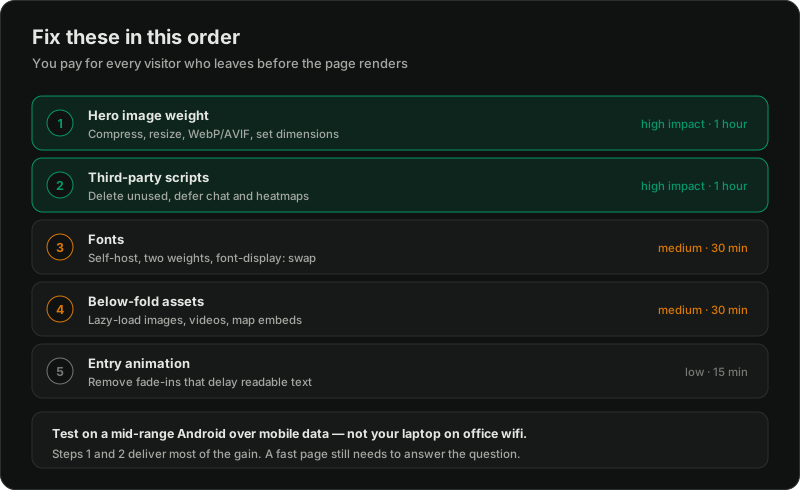
Test on a real mid-range Android over mobile data. Not your laptop on office wifi. The gap between those two experiences is where most of your lost conversions live.
In priority order
1. The hero image
The single most common problem. An uncompressed 2–4 MB hero is a multi-second wait on mobile data before anyone sees anything.
Getting this right often takes seconds off, for an hour of work. Nothing else on the list has that ratio.
2. Third-party scripts
Chat widgets, heatmap tools, review widgets, social embeds, multiple tag containers. Each one is a request to someone else's server, and each blocks or delays rendering.
This is also where server-side tagging helps as a side effect: fewer browser scripts.
3. Fonts
Custom fonts block text rendering or cause a visible flash.
font-display: swap so text shows immediately in a fallback.4. What's above the fold
The fastest request is the one you never make. Most landing pages load the entire page before showing anything.
The Quality Score angle
For Google Ads, landing page experience feeds Ad Rank, which affects both position and cost per click. A faster page can genuinely lower what you pay for the same placement — the mechanics are in Quality Score.
So speed pays twice on paid traffic: more of the visitors you bought actually arrive, and each one can cost slightly less.
A realistic sequence
1. Compress and correctly size the hero image, set explicit dimensions.
2. Audit third-party scripts; delete or defer everything non-essential.
3. Self-host fonts, two weights, font-display: swap.
4. Lazy-load everything below the fold.
5. Re-test on a mid-range phone on mobile data.
Steps 1 and 2 usually deliver most of the gain. If you get through them and the page still feels slow, the problem is likely the platform or theme, not the assets — which is a different conversation.
Speed is necessary, not sufficient
A fast page that doesn't answer the visitor's question still won't convert. Speed removes a barrier; it doesn't create persuasion. Once the page loads quickly, the constraint moves to what it says — the structure for that is in the lead-gen landing page checklist, and for clinics specifically in the clinic landing page.
And if traffic is modest, measure the change over a long enough window rather than trying to A/B test it — the approach is in testing a landing page without much traffic.
Want the page audited?
Most landing pages I look at have two or three fixable problems costing a visible share of paid traffic, and the owner has never loaded the page on a real phone on mobile data.
Related reading:

Written by
Vince Servidad
PPC & Creative Strategist
I manage Google Ads and Meta Ads for ecommerce, healthcare, SaaS, events and nonprofits, with creative strategy, Shopify development and conversion tracking.