Google Ads
Server-Side Tagging: What It Actually Fixes (and When It's Not Worth It)
Server-side tagging is sold as a fix for tracking loss. It does recover data — but not all of it, and not for free. Here's what it genuinely solves, what it doesn't, and how to decide whether your account needs it.

PPC & Creative Strategist
Server-side tagging gets pitched two ways, both wrong. Either it's a magic fix that restores all your lost conversions, or it's enterprise overkill nobody needs.
It's neither. It's a specific tool that solves a specific set of problems, costs real money and real setup time, and is clearly worth it above a certain spend level and clearly not below it. Here's how to tell which side you're on.
TL;DR
What it actually is
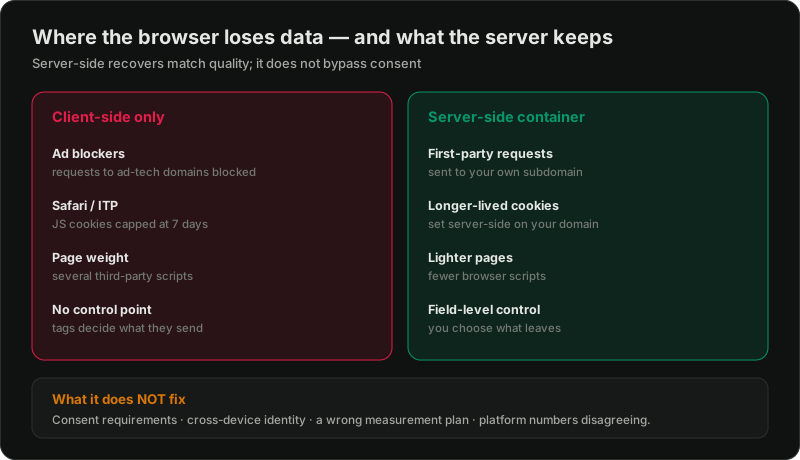
Normally your tags run in the visitor's browser. The browser loads Google's and Meta's scripts, those scripts read cookies, and they send data straight to the platforms.
Server-side tagging inserts a step. The browser sends one request to your own server endpoint, on your own domain, and that server decides what to forward to Google, Meta, and anywhere else.
The consequences follow from that one change:
What it genuinely fixes
Ad blocker loss. A meaningful share of visitors block requests to known ad-tech domains. A request to your own domain usually isn't blocked. Straight recovery.
Safari/ITP cookie expiry. ITP caps JavaScript-set cookies at seven days, so a returning visitor after two weeks looks brand new. A server-set cookie on your own domain isn't capped the same way — attribution windows stop collapsing.
Page speed. Removing several third-party scripts measurably helps load time, which helps conversion rate and Quality Score independent of tracking. See Quality Score.
Data control. Strip fields before they leave. Required for health data, useful everywhere.
What it doesn't fix
Consent. Server-side does not let you track people who declined. If consent is required in your market, it's required in both architectures. Anyone selling server-side as a consent workaround is describing a compliance problem, not a feature.
Cross-device and logged-out attribution. It improves match quality; it does not solve identity.
A bad measurement plan. If you're optimising toward the wrong event, server-side makes you wrong more accurately. Fix what you're measuring first — for lead-gen that means tracking the outcome, not the form fill.
Perfect platform agreement. Your numbers still won't match across Google, Meta, GA4, and your store, for the reasons in why the platform numbers don't match.
What it costs
That last point is the real cost. A broken browser tag is usually noticed quickly. A broken server container can quietly under-report for weeks.
How to decide
Do it if you spend enough that a 10–20% swing in measured conversions changes real budget decisions; you rely on Smart Bidding or Advantage+ (both are only as good as the conversion data they see); a large share of your traffic is Safari or iOS; or you're in a regulated category where field-level control isn't optional.
Don't do it yet if you're spending small amounts, your conversion volume is too low for bidding to be data-driven, or your basic tracking isn't right. Fix the fundamentals first — GTM and Google Ads, conversion tracking, then enhanced conversions, which is free and recovers much of the same loss.
The honest sequence for most accounts: get conversion tracking correct → turn on enhanced conversions and Meta CAPI → *then* consider server-side. Most accounts that "need server-side" actually need step one.
If you do it, do these
1. Use a custom subdomain (e.g. sgtm.yourdomain.com), not a provider default — a third-party hostname loses you the first-party benefit.
2. Run both in parallel first. Keep client-side live, add server-side, compare for two weeks. Never cut over blind.
3. Instrument the server container itself — you need to know when it stops receiving or forwarding.
4. Document what fields are forwarded where. In six months nobody remembers, and this is the document that makes an audit possible.
5. Re-verify consent behaviour end to end after the move. This is the most common thing to get quietly wrong.
Want a straight answer on whether you need it?
The useful question isn't "is server-side better" — it's "what is my current setup actually losing, and would this recover enough to justify the ownership cost." That's answerable in an audit, and often the answer is "fix these three cheaper things first."
Related reading:

Written by
Vince Servidad
PPC & Creative Strategist
I manage Google Ads and Meta Ads for ecommerce, healthcare, SaaS, events and nonprofits, with creative strategy, Shopify development and conversion tracking.