Healthcare
The Clinic Landing Page That Turns Enquiries Into Booked Appointments
Clinic landing pages lose patients at predictable points: no named practitioner, no price signal, no first-visit explanation, and a booking step that asks for too much. Here's the page structure that fixes it.

PPC & Creative Strategist
Someone with a health concern clicks your ad. They are anxious, comparing two or three clinics, and deciding largely on trust. Most clinic landing pages give them a hero image, a slogan, and a contact form.
The page has to answer a specific set of questions, in roughly the order a nervous person asks them. When it does, enquiry rates go up and — more importantly — the enquiries that arrive are further along and more likely to book.
TL;DR
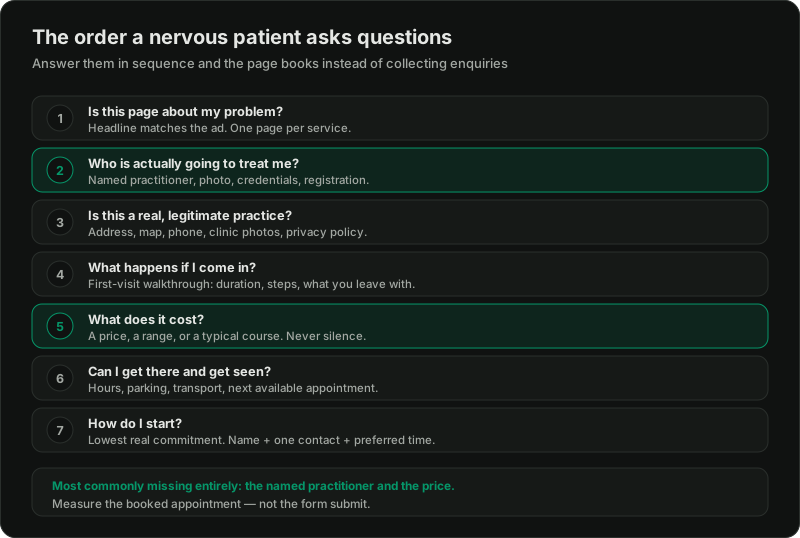
The seven questions, in order
1. "Is this page about my problem?"
Match the ad. If the ad said "knee pain physiotherapy," the headline says knee pain physiotherapy. Not "Welcome to Our Clinic."
This is also a policy issue, not just conversion — ad-to-page mismatch is a common cause of healthcare disapprovals, covered in the Google Ads healthcare policy guide.
One page per service. A homepage cannot answer this question for six different treatments at once.
2. "Who is actually going to treat me?"
The highest-leverage element on a clinic page, and the most commonly missing.
Name the practitioner. Real photo, real credentials, years practising, where they trained, professional registration number where that's normal in your market. "Our team of experienced professionals" is worth nothing — the patient is trying to work out whether a specific human is competent to treat them.
If you have several practitioners, show the ones relevant to this service, not the full staff directory.
3. "Is this a real, legitimate practice?"
For a health decision, absence of these reads as risk. This is also what Google looks for when assessing whether a medical destination is a real business.
4. "What actually happens if I come in?"
Anxiety is the main reason people delay booking a medical appointment. Remove the unknown.
A short first-visit walkthrough does more work than any testimonial:
Your first visit: A 30-minute assessment. We'll ask about your history, examine the area, and explain what we think is happening. You'll leave with a written plan and a cost estimate. No treatment happens on the first visit unless you want it to.
Duration, what happens, what they leave with, and what won't happen without consent. That last part matters more than clinics expect.
5. "What does it cost?"
Most clinics refuse to answer this, and it costs them bookings. People assume the worst and go to whoever was transparent.
You don't need a fixed price list. Any of these works:
Anything beats silence. It also pre-qualifies — people who can't afford it don't become enquiries you spend time on.
6. "Can I actually get there and get seen?"
Opening hours, including whether you do evenings or weekends. Parking. Nearest transport. How soon the next appointment is — "next available: Thursday" converts, "contact us for availability" doesn't.
7. "How do I start, and how little can I commit?"
Offer the lowest-commitment step that is still real. "Book a 15-minute call" or "Request a callback" converts better than "Book an appointment" for higher-consideration treatments, and much better than "Contact us."
The booking form is where it leaks
Medical forms feel more invasive than other forms, so every field costs more.
Ask for: name, one contact method, and preferred time. That's it.
Don't ask on the landing page: date of birth, address, insurance details, symptom descriptions, medical history, ID numbers. Collect those after they've booked, in your booking system, where they belong. Putting intake questions on a landing page tanks completion and creates a data problem — those answers are sensitive health information sitting in your form tool and possibly in your analytics.
If your form asks for symptoms, it's also a tracking risk. See healthcare conversion tracking for what leaks and how.
Two more things that help:
Measure the booking, not the enquiry
Optimising toward form submissions gets you more form submissions, including the ones that never book. For a clinic the number that matters is a confirmed appointment, and often the number after that — the patient who actually attended.
appointment_booked from the booking system, not the form submit.Testing this when you don't have much traffic
Most clinics don't have the volume for a clean A/B test, and that's fine — the fixes above aren't close calls. Ship the whole set, then measure the before/after over a long enough window, and prioritise changes by how many patients they plausibly affect. The approach for low-traffic testing is in testing a landing page without much traffic.
Start with whichever of the seven questions your page currently doesn't answer at all. That's almost always the practitioner, the price, or the first visit.
Want the page built or reviewed?
Clinic pages fail in consistent, findable ways, and the fixes are usually a morning's work rather than a rebuild. Auditing and rebuilding these is part of my landing page conversion and healthcare ads work.
Related reading:

Written by
Vince Servidad
PPC & Creative Strategist
I manage Google Ads and Meta Ads for ecommerce, healthcare, SaaS, events and nonprofits, with creative strategy, Shopify development and conversion tracking.