Healthcare
Google Ads Healthcare Policy: What You Can and Can't Advertise
Clinic ads get disapproved for reasons that look arbitrary until you understand how Google sorts healthcare content. Here's the model, what needs certification, and how to fix the disapprovals that keep coming back.

PPC & Creative Strategist
Healthcare disapprovals feel random. The same ad runs for six months, then stops. A competitor advertises something you were told you can't. An appeal succeeds once and fails the next time with identical copy.
It's less arbitrary than it looks. Google sorts healthcare advertising into a few buckets, and which bucket you're in determines whether you need certification, whether the restriction is country-specific, and whether an appeal is worth filing. Once you can place yourself, most of the confusion resolves.
TL;DR
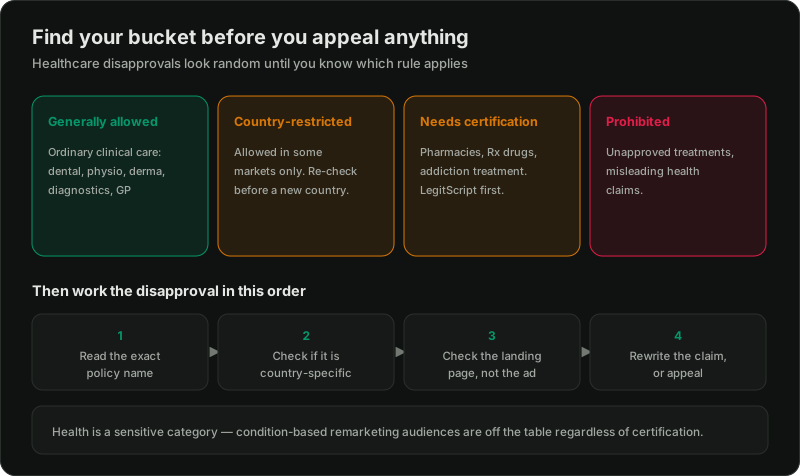
The four buckets
1. Generally allowed. General health information, and most ordinary clinical services — dentistry, physiotherapy, optometry, dermatology, general practice, diagnostics. If you're a normal clinic advertising normal services, this is you, and no certification is required.
2. Restricted, varying by country. A category permitted in some markets and not others, sometimes with extra conditions. Google applies policy per targeted country, which is why a campaign expanding into a new market can suddenly show disapprovals on ads that ran fine for a year.
3. Certification required. Specific categories where you must be certified before you can advertise at all — online pharmacies, prescription drug advertising, addiction treatment services in several countries, and some clinical trial recruitment. Certification generally runs through LegitScript, then you apply to Google with it. Budget weeks, not days, and there's a fee.
4. Prohibited. Won't run regardless of certification: unapproved or speculative treatments, misleading health claims, and anything promising outcomes it can't deliver.
Before you do anything else, work out which bucket you're in. Appealing a certification-required disapproval as though it were a copy problem is the most common wasted week I see.
What trips up ordinary clinics
Most clinics sit squarely in bucket one and still collect disapprovals. Nearly always for one of these:
Outcome claims. "Permanent results," "guaranteed," "cure," "100% success." Also implied guarantees — "finally get rid of X." Describe the treatment and who it's for. Let the results page carry evidence, with proper qualification.
Condition-targeting language in ad copy. Ads that read like they know something about the searcher. Google's personalised advertising rules restrict health as a sensitive category, and copy that presumes a diagnosis draws scrutiny. Same discipline as Meta's personal attributes rule, covered in the Meta clinic rules post.
Landing page mismatch. The ad promises a specific treatment; the landing page is a generic homepage. This gets read as a destination problem and it's the most common *repeat* disapproval — people keep editing the ad when the page is what's failing.
Missing trust signals on the destination. For health, Google expects a real business: clear contact details, a physical address, practitioner credentials, a privacy policy. A thin one-page site with a form and no named practitioner is a weak destination for a medical query.
Restricted terms you didn't intend to bid on. Broad match drifting into prescription drug names or restricted treatment terms. Search terms report, then negatives — the process in negative keywords.
Fixing a disapproval, in order
1. Read the actual policy name in the disapproval, not just the summary. "Healthcare and medicines" and "Misrepresentation" need completely different fixes.
2. Check whether it's country-specific. If you target several countries, look at whether it applies to all of them. Sometimes the fix is targeting, not content.
3. Check the landing page before the ad. Load it as a stranger. Does it deliver what the ad promised, and does it look like a real practice?
4. Rewrite rather than appeal, when it's a claim. Appeals on genuine claim violations mostly fail, and repeated failed appeals aren't good for the account.
5. Appeal when you're genuinely in bucket one and have been misclassified — this happens, and appeals do succeed. Include why your service is ordinary clinical care.
6. Start certification early if you're actually in bucket three. Nothing else unblocks you.
The remarketing limit worth knowing
Even fully compliant, you cannot build remarketing audiences around health conditions or treatments. Google's personalised advertising policy treats health as sensitive, so "everyone who visited the fertility treatment page" is not an audience you may build.
This surprises people who've built their whole funnel plan around it. What you can do: remarket on non-sensitive behaviour — general site visitors, people who viewed your locations or pricing page — and let creative do the qualifying rather than the audience definition. Same principle as the Meta side: the message qualifies, not the targeting.
It's also why the tracking design matters. If your booking URLs contain the condition, your audiences may be sensitive without you intending it — the leak paths are in healthcare conversion tracking.
Keep policy from becoming a recurring tax
Policy specifics change. Treat the buckets and the diagnostic order as durable; verify current details against Google's published healthcare and medicines policy for the countries you target before you rely on them.
If the disapprovals keep coming back
Recurring healthcare disapprovals are usually a structural problem — the landing pages aren't built for the queries, or the account is bidding into terms it shouldn't be. Fixing it once, properly, beats appealing monthly.
Related reading:

Written by
Vince Servidad
PPC & Creative Strategist
I manage Google Ads and Meta Ads for ecommerce, healthcare, SaaS, events and nonprofits, with creative strategy, Shopify development and conversion tracking.