Healthcare
Meta Ads for Clinics: The Targeting and Creative Rules That Actually Apply
No, healthcare is not a Special Ad Category — but health-condition targeting is gone and the personal attributes policy will get your ads rejected. Here's what actually restricts clinic advertising on Meta, and what to run instead.

PPC & Creative Strategist
Most clinic owners I talk to have heard two things about Meta Ads, and one of them is wrong.
The wrong one: "healthcare is a Special Ad Category, so you're limited like housing and credit ads." It isn't. The right one: "you can't target people by their medical condition anymore." That's true, and it changed how clinic campaigns have to be built.
This is what actually restricts healthcare advertising on Meta, why ads get rejected, and what a campaign looks like once you stop trying to target the condition.
TL;DR
The Special Ad Category myth
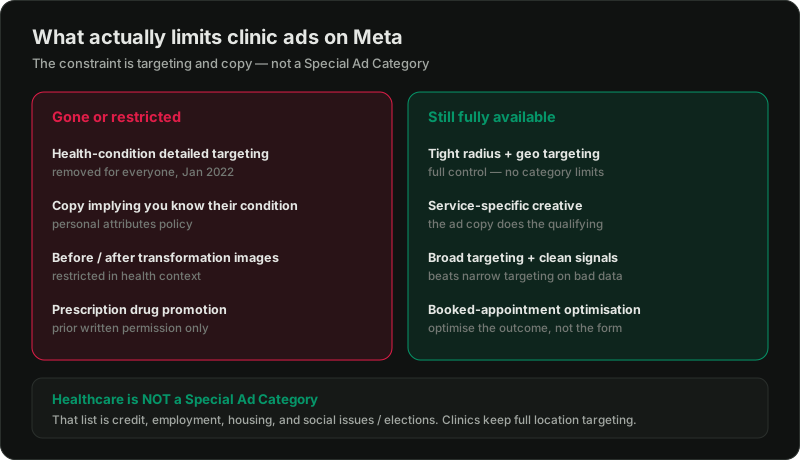
Meta's Special Ad Category exists because of anti-discrimination law. It covers ads for credit, employment, housing, and social issues, elections or politics. Those categories lose detailed targeting, narrow age/gender targeting, and get a minimum radius on location targeting.
Healthcare is not on that list. A dental clinic, a derma clinic, a physiotherapy practice, or a diagnostics lab declares no Special Ad Category and keeps normal targeting controls — including tight radius targeting around the clinic, which matters enormously for a business people travel to.
This matters practically: if someone set your account up with a Special Ad Category declared "to be safe," they crippled your location targeting for no reason. Check it. It's on the campaign level.
What actually changed: condition targeting is gone
In January 2022 Meta removed detailed targeting options tied to sensitive topics — health causes among them. Interests like "diabetes awareness" or "cancer awareness" no longer exist as targeting options for anyone. This was a removal, not a restriction you can apply for.
The instinct is to find a workaround: target interests that correlate with the condition, or build a lookalike from patients with that condition. Resist both.
The policy that actually gets clinic ads rejected
Personal attributes. Meta's policy says your ad must not assert or imply that you know a person's personal characteristics — including their medical or physical condition.
This is the single most common reason clinic ads get disapproved, and the fix is almost always a rewrite rather than an appeal.
The rule of thumb: describe the service, not the reader.
| Rejected — implies knowledge | Approved — describes the offer |
|---|---|
| "Struggling with acne scars?" | "Acne scar treatment, from ₱X per session" |
| "Are you diabetic?" | "Diabetes screening and management" |
| "Your back pain doesn't have to be permanent" | "Physiotherapy for back pain — book an assessment" |
| "Overweight? We can help" | "Medically supervised weight management programs" |
Second person plus a condition is the pattern to watch. "You" + "your condition" implies knowledge. Naming the service and who it's for does not.
Creative rules worth knowing before you shoot
Photography of your actual clinic, your actual team, and a clear explanation of what happens at the first visit outperforms stock imagery anyway. Prospective patients are choosing on trust.
What to build instead
Once you accept that you cannot target the condition, clinic campaigns get simpler — and usually better.
1. Let geography do the heavy lifting. For most clinics, the realistic catchment is small. A tight radius around the clinic, or around the two or three areas your patients actually come from, removes more waste than any interest stack would have. Check your patient records for real postcodes before you guess.
2. Let the creative do the qualifying. If you cannot target people with knee pain, say "knee pain" in the ad. The people it applies to self-select; everyone else scrolls past. Your creative becomes the targeting layer. This is why specific service ads beat generic "book a consultation" ads for clinics.
3. Go broad, and feed the algorithm real signals. Broad targeting plus accurate conversion data outperforms narrow targeting plus poor data. Which makes tracking quality the constraint — see the conversion tracking guide for clinics for doing this without handling patient data you shouldn't.
4. Optimise for the event that matters. A booked appointment, not a form fill or a landing page view. If your booked-appointment volume is too low to optimise on, optimise on the closest reliable upstream event and use offline conversion data to teach the platform which enquiries actually became patients — the method is in offline conversion tracking.
5. Separate high-intent from awareness. Someone searching for a specific procedure is a different campaign from someone seeing your clinic for the first time. Google usually catches the first — that's the split I cover in Google Ads for clinics.
Where Meta fits against Google for a clinic
Google captures people already looking for a procedure. Meta creates demand and reaches people who weren't searching yet, and it's usually cheaper per enquiry — with softer intent to match.
For most clinics the honest split is Google first for the procedures with real search volume, Meta second for the ones people don't know to search for, plus retargeting. If your budget only supports one channel and patients are actively searching for what you do, start with Google.
Getting the setup checked
The two things worth auditing on a clinic Meta account: whether a Special Ad Category was declared unnecessarily, and whether your conversion event actually reflects a booked appointment. Both are common, both are fixable in an afternoon, and both change what the campaign can do.
Related reading:

Written by
Vince Servidad
PPC & Creative Strategist
I manage Google Ads and Meta Ads for ecommerce, healthcare, SaaS, events and nonprofits, with creative strategy, Shopify development and conversion tracking.