Healthcare
Cost Per Patient: Setting a Clinic Ads Budget From Real Economics
Cost per lead tells you almost nothing about whether clinic ads are working. Work backward from what a patient is actually worth over their treatment course, and the budget question answers itself.

PPC & Creative Strategist
"Our cost per lead is ₱400, is that good?"
I can't answer that, and neither can anyone else, because cost per lead isn't a business number. It becomes one only after you know how many leads book, how many booked patients attend, and what an attending patient is worth over the course of their treatment.
Once you have those four numbers, the budget question stops being a guess. Here's how to build them for a clinic, including the part most practices get wrong — patient value is almost never the consultation fee.
TL;DR
The four numbers you need
1. Enquiry → booked rate. Of everyone who fills the form or calls, what share actually books an appointment? For most clinics this sits well below what the owner assumes. Get it from your booking system, not memory.
2. Booked → attended rate. No-shows are a real and often large leak. A clinic with 30% no-shows is paying for every one of them.
3. Average treatment course value. Not the consultation fee. What does a patient who comes in for this service typically spend before they're done? A ₱1,500 dermatology consult that usually leads to a ₱25,000 treatment course is a ₱26,500 patient, and budgeting on ₱1,500 will cause you to underspend into irrelevance.
4. Repeat and referral value. Some services are one-off. Many are not — dental, physio, aesthetics, chronic condition management all have return visits. If you have the records, look at 12- or 24-month patient value rather than first-course value.
Worked example
A physiotherapy clinic:
| Step | Rate | Result from 100 enquiries |
|---|---|---|
| Enquiries | — | 100 |
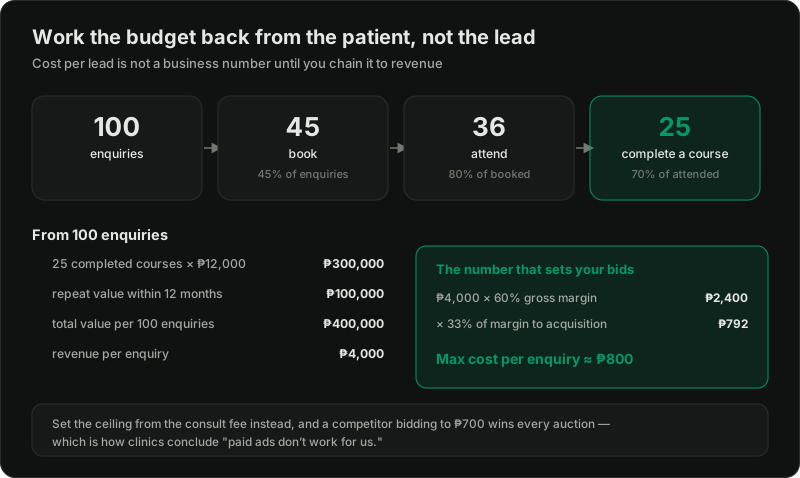
| Book an appointment | 45% | 45 |
| Attend | 80% | 36 |
| Complete a treatment course | 70% | 25 |
Average course value: ₱12,000. Average completed patient also returns for roughly ₱4,000 within 12 months.
Value from 100 enquiries:** 36 attending patients. Of those, 25 complete a course at ₱12,000 = ₱300,000, plus repeat value of about ₱100,000 across returners. Call it **₱400,000 from 100 enquiries — ₱4,000 per enquiry in revenue.
Now the acquisition ceiling. Say gross margin after clinical time, materials, and room cost is 60%, and you're willing to spend a third of gross margin on acquiring the patient:
₱4,000 × 60% = ₱2,400 gross margin per enquiry.
₱2,400 × 33% = ₱800 maximum cost per enquiry.
So a ₱400 cost per lead isn't just "good" — it's leaving room to scale. And if a competing clinic is bidding to ₱700 because they did this maths and you didn't, they win the auction and you conclude "Google Ads doesn't work for us."
That is the actual reason most clinics underperform on paid: not bad campaigns, an acquisition ceiling set from the consult fee.
Where clinics get this wrong
Using the consult fee as patient value. The most expensive mistake in the list, and the most common.
Ignoring no-shows. They sit between "booked" and "revenue" and quietly inflate every number upstream. If you cut no-shows from 30% to 15% with reminders, you improve acquisition economics without touching the ad account.
Counting revenue instead of margin. Clinical time is a real constraint. A service that books out your best practitioner at low margin isn't the one to scale.
Averaging across services with different economics. An aesthetics course and a single check-up are different businesses. If your services vary a lot, do this per service — the budget should follow the economics, not be split evenly.
Not counting phone calls. If a large share of bookings come by phone and calls aren't tracked, your measured cost per enquiry is badly overstated and you'll underspend on the channels driving calls.
Turning it into a budget
Once you have a maximum cost per enquiry, budget becomes arithmetic against capacity:
1. Start from capacity, not ambition. How many new patients can you actually see per month without damaging service? A clinic that generates 60 enquiries with room for 20 patients has a scheduling problem, not a marketing win.
2. Target patients per month × cost per patient = monthly budget. In the example: 36 attending patients per 100 enquiries at ₱800 max per enquiry means about ₱2,200 in ad spend per attending patient. Want 20 new patients a month? Roughly ₱44,000, at the ceiling.
3. Manage to a target below the ceiling. Run at 60–70% of your maximum so there's margin for a bad month and headroom to bid up on your best services.
4. Re-check quarterly. Rates move. No-show rate especially.
The general version of this reasoning, for any business, is in how much you should spend on ads.
Making the numbers measurable
None of this works if the data isn't connected. Two things make it real:
Once value flows back, you can let the platform bid toward high-value services automatically instead of managing every bid by hand.
The uncomfortable part
Doing this honestly sometimes shows that a service can't support paid acquisition at current pricing or conversion rates. That's genuinely useful. The response isn't necessarily to stop advertising — it's usually to fix the constraint: raise the booking rate, cut no-shows, improve the landing page, or reprice.
Those changes often move the economics further than any campaign optimisation would.
Want this modelled with your numbers?
Building this for a specific practice — pulling the real rates, working out per-service ceilings, and connecting the data so the platforms can bid on it — is the diagnosis half of my healthcare ads work.
Related reading:

Written by
Vince Servidad
PPC & Creative Strategist
I manage Google Ads and Meta Ads for ecommerce, healthcare, SaaS, events and nonprofits, with creative strategy, Shopify development and conversion tracking.