Home Services Google Ads Audit: 12 Checks Before You Increase Budget
More leads will not fix the wrong jobs, missed calls, slow follow-up, or bidding that cannot see revenue. Use this practical audit to find where paid traffic is leaking before you spend more.

When a roofing, HVAC, plumbing, electrical, solar, restoration, or remodeling campaign stops producing enough work, the default answer is usually: increase the budget.
That is often the most expensive answer.
A home services campaign is not just an ad account. It is a chain:
search → click → call or form → qualified enquiry → site visit or quote → booked job → completed revenue
If one link is weak, buying more clicks simply sends more money into the same leak. This audit shows you where to look before you raise spend.
TL;DR
Start with the number the ad platforms cannot see
Before opening Google Ads, answer four questions for every service line:
| Service line | Average job value | Gross margin | Enquiry-to-booked rate | Maximum cost per booked job |
|---|---|---|---|---|
| Emergency repair | Your number | Your number | Your number | Your number |
| Planned replacement | Your number | Your number | Your number | Your number |
| Installation | Your number | Your number | Your number | Your number |
| Maintenance | Your number | Your number | Your number | Your number |
Do not use one blended average. A drain clearance and a whole-home repipe are not the same conversion. Neither are an aircon service and a full HVAC replacement.
Your acquisition ceiling comes from margin:
Maximum cost per booked job = gross profit per job × the percentage of gross profit you are willing to spend acquiring it.
The complete calculation is in Cost Per Booked Job for Trades. Without this number, “good CPL” and “expensive click” are opinions.
The 12-point home services Google Ads audit
Score each check:
A score below 18 means increasing budget is premature.
1. Are campaigns separated by service economics?
A campaign should not force low-value repairs and high-value replacements to share the same budget and bidding signal.
At minimum, separate service lines when they have materially different:
If one campaign contains “roof leak repair,” “roof replacement,” and “gutter cleaning,” Google will usually find more of whichever action is easiest—not necessarily the work that makes the most money.
Pass when: you can report spend, qualified enquiries, booked jobs, and revenue by service line.2. Is emergency demand separated from planned demand?
Someone searching “emergency plumber near me” at midnight behaves differently from someone comparing bathroom renovation quotes.
Emergency work is won through:
Planned work is won through:
They need different campaigns, schedules, copy, landing pages, and bids. See the full emergency versus planned demand structure.
Pass when: urgent and considered searches cannot drift into each other's campaign.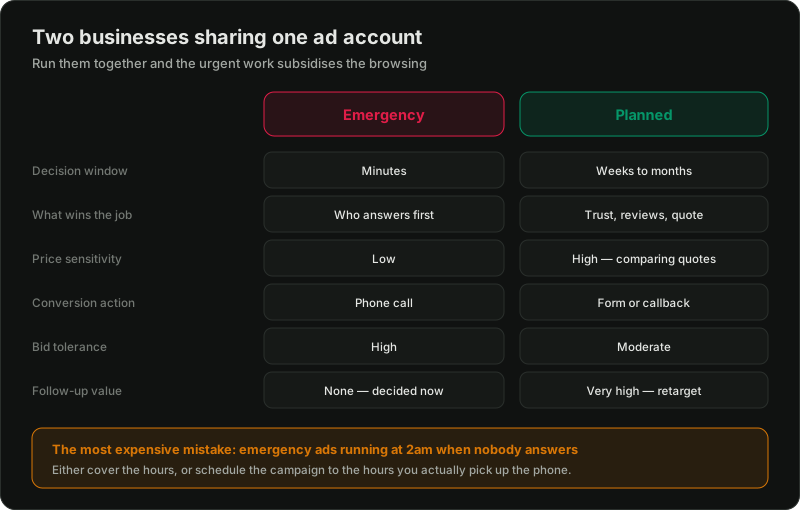
3. Do locations match where crews can profitably work?
“We serve the whole region” is rarely a useful targeting rule.
Map the real service area by:
Exclude places you cannot serve promptly or profitably. Review the user-location report—not just the location keywords—to catch clicks from outside the actual area.
Pass when: every targeted area has operational coverage and a defensible job-value ceiling.4. Do search terms describe jobs you actually want?
Keywords are your plan. Search terms are what you paid for.
Review them weekly and classify each query:
Add negatives from real waste, not from an enormous copied list that may block good work. For a structured approach, use the service-business keyword research guide.
Pass when: at least 90% of meaningful spend is attached to commercially relevant searches.5. Does each ad make the next step obvious?
Home services ads do not need clever slogans. They need to match the job and reduce uncertainty.
A strong Search ad answers:
1. Do you do this exact job?
2. Do you cover my location?
3. Why should I trust you?
4. Can I call or request a quote now?
Use real differentiators: answering hours, licence or accreditation, warranty, financing, response window, years operating, review volume, or specialist experience. Do not claim “best” or “#1” without evidence.
Pass when: the ad could not be swapped with a competitor's name and still read the same.6. Does the landing page continue the same conversation?
Do not send every click to the homepage.
A service-specific landing page should include:
Use the lead-generation landing page checklist to inspect the page section by section.
Pass when: a visitor can confirm fit, trust the business, and act without opening the navigation.7. Are phone calls measured as business outcomes?
For many trades, calls are the highest-intent conversions and the least understood.
Track:
A 60-second call threshold is not proof of quality. A long supplier call can be worthless; a two-minute emergency booking can be valuable. The setup options are covered in call tracking for PPC.
Pass when: you can trace a booked phone enquiry back to its campaign.8. Do forms capture enough context without killing conversion?
Ask only what is needed to route and respond:
Do not force a customer with a leaking ceiling to complete a project brief. Collect detailed qualification on the call.
Every form should:
9. How fast does a real person respond?
Run a mystery-shopper test during business hours.
Submit a form and record:
The lead may be perfectly good and still be lost because three competitors responded first. Fix the workflow in Speed to Lead for Home Services.
Pass when: urgent enquiries receive immediate attention and planned enquiries receive human contact within the promised window.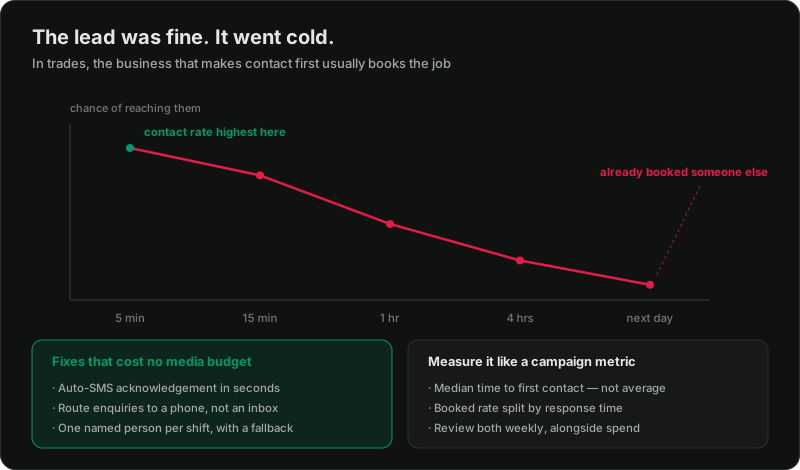
10. Does bidding learn from qualified or booked work?
If every form and call is marked as equally valuable, automated bidding will find the easiest leads—not the best jobs.
Build a conversion ladder:
1. Enquiry
2. Qualified enquiry
3. Quote or site visit
4. Booked job
5. Completed job and value
Import deeper outcomes through your CRM or an offline conversion tracking workflow. Start with reliable qualified or booked events; do not wait for a perfect enterprise CRM.
Pass when: the primary bidding conversion represents genuine commercial value, not a button click.11. Does budget follow capacity and seasonality?
More demand is not useful when the diary is full, the estimator is away, or the campaign runs after phones stop being answered.
Adjust budget around:
Keep headroom for high-demand periods instead of exhausting the monthly budget evenly. Use seasonal budget pacing to turn that into a schedule.
Pass when: spend expands and contracts with the business's ability to answer, quote, and complete profitable work.12. Does the weekly report lead to a decision?
A useful report is not a screenshot of clicks and impressions.
Review this weekly:
| Metric | Why it matters |
|---|---|
| Spend by service line | Shows where budget went |
| Qualified enquiries | Removes spam and wrong jobs |
| Booked jobs | Connects advertising to operations |
| Cost per booked job | Shows acquisition efficiency |
| Booked revenue and margin | Shows commercial value |
| Answer rate and response time | Exposes intake leakage |
| Search-term waste | Identifies immediate exclusions |
| Capacity next week | Guides budget changes |
End the meeting with three decisions: what to stop, what to fix, and what to scale.
Pass when: the report changes an operational or media decision every week.Your score and what to do next
| Score | Diagnosis | Next move |
|---|---|---|
| 21–24 | Strong foundation | Scale the profitable service lines carefully |
| 18–20 | Mostly sound | Fix the lowest-scoring checks before adding budget |
| 12–17 | Material leakage | Prioritise tracking, intake, and campaign structure |
| 0–11 | Spend is largely ungoverned | Rebuild measurement before trusting platform results |
Do not treat the score as a vanity benchmark. The purpose is to reveal the first constraint.
A practical 30-day repair plan
Week 1: Establish the economics
Week 2: Repair measurement
Week 3: Repair the customer journey
Week 4: Give bidding better signals
Only then decide whether the account needs more budget.
When specialist help is worth paying for
You probably do not need a specialist to add a few negative keywords.
You may need one when:
That is the work behind my home services PPC service: campaign structure, call and form measurement, landing-page diagnosis, offline outcomes, and budget decisions tied to booked jobs.
If you want a clear first diagnosis, send your website, service lines, locations, and current monthly spend. I will tell you what I would inspect first and whether I am the right person to help.
Related reading:

Written by
Vince Servidad
PPC Strategist · Google Ads, Meta Ads & conversion systems
Filipino PPC strategist. A seven-figure Shopify brand and 10+ years across Google Ads, Meta Ads, stores, tracking, and content.
Need help with Home Services?
Get strategic and hands-on support from a PPC strategist based in the Philippines.